When Alex's autism was first diagnosed, I was only 29 years old and still a relatively new mom. Jessica was born when I was 25, and Alex followed 19 1/2 months later. I remember wishing desperately for some sort of crystal ball to let me see into the future and let me know that everything would be okay. I have never been good with uncertainty, and the unknown path that lay before me was terrifying.
I'm still no good with uncertainty (waiting for Alex's cancer diagnosis was more agonizing than dealing with the news), but I have learned over time that life just has to unfold. I suppose that's not an earth shattering statement, but I know now that in order to fully appreciate your life you just have to live it, every day.
Autism was still relatively obscure back in 1992, when Alex was diagnosed. As a teacher, it was not completely unknown to me, but my information was limited and outdated. I still have the college textbook that contained roughly one paragraph about autism, and the gist of it was that students with autism were so significantly disabled that they would never be in my regular education classroom. Mind you, this was in the college textbook for my class about "mainstreaming" special education students. The year was 1984, and PL 94-142 (now IDEA) was still fairly new. I had one three credit course to prepare me for working with differently abled learners in my classroom. In addition to that paragraph, we watched a film (yup, a film on a film reel and a film projector - I had to learn how to thread and run those things as a requirement for graduation and getting my teaching license) and my professor told us that children with autism were unable to love their mothers. I remember thinking, praying, I suppose, "If I ever have a child with a disability, please let it be anything but autism. I wouldn't be able to survive having a child that couldn't love me."
Nicely played, Karma.
Add to that, the irony of John and I having a child who is nonverbal. Picture the best/worst Hallmark Channel movie about the beloved high school or college football coach who has a child who is physically disabled. (They love sports metaphor movies, don't they?) John and I met in high school debate (he, first affirmative; me, second negative - his job was to present the plan, mine was to tear it down), and almost all of our professional and leisure interests involved language and intellectual pursuits - acting, singing, theatre, reading, language, public speaking, teaching. We've had to learn to think and communicate beyond words.
The road to Alex's diagnosis was actually a series of evaluations and diagnoses over a period of almost 10 months from the time we started asking the questions to be told what we were dealing with. First, he was diagnosed with severe language delays and what they called "scatter skills," a very intriguing array of strengths and weaknesses. Then came the diagnosis of a sensory processing disorder and sensory integration therapy (very new at that time). Finally, the diagnosis of PDD.NOS. An actual "autism" diagnosis didn't come until several years later. Doctors were wary of the "autism" label and thought it kinder to give that PDD.NOS label. They didn't yet embrace the idea of autism being a true spectrum disorder. At any rate, they wanted to give us the hope that Alex would be "high functioning." Turns out his autism is much more on the classic side of things. Although, to be fair, Alex is quite an enigma.
At the speech and language meeting, where they gave us the results of the testing, I actually asked if he would still be able to go to college. I cringe at that thought now. Maybe I cringe and sympathize. I want to hug that young, naive mother, because she had so much to learn. That was the day I first started wishing for the "crystal ball." I wanted to know that someday he would talk, and he would get married, and he would go to college.
A few months later came the PDD.NOS diagnosis. That came from a different group of professionals. We had started at a private speech and language clinic. They referred us to a private occupational therapist who gave us the sensory processing diagnosis, and at the same time referred us to the county Early Intervention Program. A team came to our home for that evaluation. The team included a developmental pediatrician. They said PDD.NOS and gave me a book. I opened the book and found the chapter that explained how to set up a special needs trust because our child would never be independent. I closed the book, and didn't read much of anything - at least not anything with long range predictions, for a year.
Instead, I made it up. There were no line therapists in 1992. The doctors didn't know much, at least around here, and the teachers were still learning. Alex was at the forefront all throughout his school years. We learned alongside the teachers in our district.
I started taking graduate classes. Back then, the school district even payed the tuition for the summer coursework I took. I taught full time during the school year, and took autism classes and devised my own programming for Alex and we took care of Jessica. Every summer I took a grade class in autism. I think when he was about six the class I wanted was far enough away that I had to stay overnight. I attended with several of Alex's teachers. When we introduced ourselves and said a little about ourselves, I remember I said that one of my goals for the week was to go to a restaurant where I could eat with a fork. That never happened in those days.
My instinct, our instinct, was to make Alex feel loved and safe. We always focused on his emotional growth and well being more that rote skills. He still can't tie his own shoes, but he can accept comfort during chemotherapy, so I'd say we made the right call.
I took the lead on the therapy because education was my background, but that doesn't mean I ever did this alone. John and I were in lockstep every step of the way. John has never, ever shied away from getting messy in his parenting. And it took both of us to meet Alex's and Jessica's very diverse needs and to support each other. Luckily, we never both fell apart at the same time. John's sister, Allison, was our daycare provider and she helped raise our kids. She didn't shy away once the diagnosis came. She stepped right up. In fact, both she and John insisted I keep working because they knew the alternative was me obsessing in a way that would be unhealthy for Alex and me. They were right.
If I had had that crystal ball in 1992, I would have been devastated. I would have focused on all that we lost. I didn't know then that you could have a child grow up to still be nonverbal and require 24/7 care would could, in fact, be an amazing adult.
I didn't know then how much I could love someone.
I didn't know then how the grieving ebbs and flows forever, and that it can come crashing in on you when you least expect it.
I also didn't know that grieving for lost potential didn't mean that you lived your life in sorrow.
I couldn't have imagined that I could know my son so well. That John and I could have the strength to meet challenges that we could never have predicted.
There was a time when I thought that the autism diagnosis was the worst thing that could happen to is. I was wrong. It's just a piece of Alex and a piece of us as a family.
There was a time when I thought getting Alex through wisdom teeth surgery was a huge challenge. What a walk in the park that was. On February 11 when they told us he had cancer, we didn't know how he would be able to participate in his care and treatment. He has amazed us all.
Every where I go, I meet people who have been positively impacted by Alex's life. He touches the lives of everyone he meets. He can't speak, he won't get married, be a father, or even live completely on his own. But he is an amazing and successful adult.
I'm ashamed to say I would have been disappointed had I known this was "all" his life was meant to be. I had to live this life to fully appreciate how very, very lucky I am and have been, and to fully appreciate the amazing son I have.
I know that there are people who feel sorry for me, and for our family. I wish Alex's life were easier, especially now, as he battles cancer. Cancer sucks much more than autism does. I hate the part of autism that makes Alex's life harder for him. But I wouldn't change who he is for anything.
So don't feel sorry for me. I have lived the life I was meant to live. I have an amazing family and we have an unbreakable bond. I've felt sorrow and heartache, and right now we are going through a particularly hard time, but I have experienced more joy and love and wonder in my life than I ever thought possible. I don't have a crystal ball, and that's okay. I'm learning to live it and appreciate it, just as it comes.
Saturday, May 30, 2015


Wednesday, May 13, 2015
Haircuts
Alex was very focused and thoughtful during his haircut. John, Frank, and I were all talking about how much to cut off, how it would look, and how it might feel. We knew that the "chemo haircut" was most likely going to happen, the timing was really the question. It was also another one of those situations where Alex most certainly had an opinion, but was unable to express it. So John and I have to do our best to execute Alex's wishes, without actually knowing for sure what they are.
I'd asked the nurse (actually, all the nurses and all the doctors) about whether or not Alex would lose his hair. It wasn't because I was particularly worried from a vanity standpoint. My concern was for how Alex would process the situation, and what he would be experiencing. I was told that most chemo patients report discomfort in their scalps as the hair starts to fall out. Alex's senses are all hyper-acute, so I can only imagine what that might mean for him. We also wondered how he would feel with no hair - would that be better for him? Would he find it upsetting? We hoped that the moment would present itself and we would just know the time was right.
That moment presented itself last week. Alex's hair kept thinning, and we thought that the process of the hair falling out might be uncomfortable, so we scheduled an appointment with Frank. Frank has been cutting Alex's hair for over twelve years; half his life.
Alex was sitting patiently and attentively as he watched almost all of his hair disappear. We decided on a very short buzz cut; not completely bald, but just short fuzz.
In the midst of the haircut, Frank said, "I forgot how hard this is for him."
With that statement, memories came flooding back. John and I both agreed, and we all paused with the realization that we were taking for granted that Alex could sit and watch almost all of his hair disappear. To say this is a huge accomplishment for Alex is a tremendous understatement.
Haircuts used to be a major ordeal. We tried going to a barber until Alex was maybe four or five. He would become so upset, with so much wriggling and crying, that is was traumatic for all of us. (At one appointment, another customer said, "Squirt him with the water bottle. He'll stop crying.") We gave up, and John started giving Alex buzz cuts at home.
We bought a clippers, and had a spot in the basement for the haircuts. We'd put it off as long as we could, but the irony was that Alex did like his hair to get long, but he really didn't like the process of a haircut. Alex's hair grows fast, so he really needs a haircut every four weeks.
He has so many sensory issues, we could only guess what it was about the haircut that was so difficult. (And we were so much younger then, and much newer on our autism journey. And we knew no one else with a similar experience to draw from.)
We wondered then, and still wonder, if the process of cutting hair was painful for him. He hated the clippers, but he hated scissors worse. A five minute buzz cut took at least an hour. Alex would break out in a full heat rash (a full blow panic attack, I know now).
One strategy we learned was to write a social story. A social story is basically a script with photos to help an individual with autism prepare for a situation. I took pictures of Alex at each step in the process, and then wrote a story to go with it. We practiced the script before, during, and after. The purpose was to make it clear to Alex what would happen and what he could expect. The script would also hopefully bridge the gap that the verbal communication might not be able to overcome. Verbal language was difficult for him (still is) and add a very stressful situation and it was difficult to know how much he could understand.
The story helped, but it was still difficult for Alex to understand how long the haircut would take. I decided to create a puzzle. On the puzzle was a picture of Alex. I cut it into six pieces, and at intervals throughout the haircut Alex got to remove a piece of the puzzle. It was timed so that when the haircut was finished, removing the last piece would reveal the final line from the social story: "Alex's haircut is all done. Hurray!"


We used that social story and puzzle for seven years. Seven years of haircuts in the basement, with Alex crying and having a panic attack, me holding him, and John dancing around him trying to get a halfway decent haircut.
By the time Alex was about twelve, the haircuts were finally getting easier. I really wanted him to have a haircut that looked more like the other boys. (Buzz cuts were not the style when Alex was small.) So we tried taking him back to the barber. Frank was a great sport. In the beginning, it took at least 45 minutes at the hair salon. Frank had to dance around Alex and try to clip a moving target. Frank used the clippers, too, but also tried to do some with the scissors. Frank's technique was better than ours, but getting a haircut was no easy task. Luckily, we were usually the last appointment of the day, because Frank was sweating profusely by the end of the haircut. He got quite a workout. Alex didn't cry, but he was anxious an unable to sit still. We had John get his haircut at the same time, so Alex could watch his dad and then get his own haircut. That process seemed to help.
Gradually, over the course of the last twelve years, haircuts have gotten easier. Alex prefers to keep his hair short, and so the positive of keeping it short outweighs the stress and discomfort of the hair-cutting process. The routine, people, and place are all familiar. Alex does so well, that usually his caregivers from his house bring him for his haircuts now.
But this time we wanted to bring him in ourselves. We weren't sure how short the haircut would have to go, and we wanted to make the decision. We wanted to be the ones to make the decision we thought Alex would make for himself if he could.
I think he agreed. His brow was furrowed, but he wasn't anxious. After it was all over, we went for dinner. He was relaxed and all smiles. I think we were successful.


It was good to remember how far Alex has come. It reminded us to appreciate that the little boy who was unable to tolerate a simple haircut, could now get his head practically shaved because of cancer. That same boy endures surgery, PET scans, doctors' appointments, and chemo. I remember when I used to wish that he could just get a "real" haircut from a barber. You've come such a long, long way, Alex John. I'm proud of you.
I'd asked the nurse (actually, all the nurses and all the doctors) about whether or not Alex would lose his hair. It wasn't because I was particularly worried from a vanity standpoint. My concern was for how Alex would process the situation, and what he would be experiencing. I was told that most chemo patients report discomfort in their scalps as the hair starts to fall out. Alex's senses are all hyper-acute, so I can only imagine what that might mean for him. We also wondered how he would feel with no hair - would that be better for him? Would he find it upsetting? We hoped that the moment would present itself and we would just know the time was right.
That moment presented itself last week. Alex's hair kept thinning, and we thought that the process of the hair falling out might be uncomfortable, so we scheduled an appointment with Frank. Frank has been cutting Alex's hair for over twelve years; half his life.
Alex was sitting patiently and attentively as he watched almost all of his hair disappear. We decided on a very short buzz cut; not completely bald, but just short fuzz.
In the midst of the haircut, Frank said, "I forgot how hard this is for him."
With that statement, memories came flooding back. John and I both agreed, and we all paused with the realization that we were taking for granted that Alex could sit and watch almost all of his hair disappear. To say this is a huge accomplishment for Alex is a tremendous understatement.
Haircuts used to be a major ordeal. We tried going to a barber until Alex was maybe four or five. He would become so upset, with so much wriggling and crying, that is was traumatic for all of us. (At one appointment, another customer said, "Squirt him with the water bottle. He'll stop crying.") We gave up, and John started giving Alex buzz cuts at home.
We bought a clippers, and had a spot in the basement for the haircuts. We'd put it off as long as we could, but the irony was that Alex did like his hair to get long, but he really didn't like the process of a haircut. Alex's hair grows fast, so he really needs a haircut every four weeks.
He has so many sensory issues, we could only guess what it was about the haircut that was so difficult. (And we were so much younger then, and much newer on our autism journey. And we knew no one else with a similar experience to draw from.)
We wondered then, and still wonder, if the process of cutting hair was painful for him. He hated the clippers, but he hated scissors worse. A five minute buzz cut took at least an hour. Alex would break out in a full heat rash (a full blow panic attack, I know now).
One strategy we learned was to write a social story. A social story is basically a script with photos to help an individual with autism prepare for a situation. I took pictures of Alex at each step in the process, and then wrote a story to go with it. We practiced the script before, during, and after. The purpose was to make it clear to Alex what would happen and what he could expect. The script would also hopefully bridge the gap that the verbal communication might not be able to overcome. Verbal language was difficult for him (still is) and add a very stressful situation and it was difficult to know how much he could understand.
The story helped, but it was still difficult for Alex to understand how long the haircut would take. I decided to create a puzzle. On the puzzle was a picture of Alex. I cut it into six pieces, and at intervals throughout the haircut Alex got to remove a piece of the puzzle. It was timed so that when the haircut was finished, removing the last piece would reveal the final line from the social story: "Alex's haircut is all done. Hurray!"


We used that social story and puzzle for seven years. Seven years of haircuts in the basement, with Alex crying and having a panic attack, me holding him, and John dancing around him trying to get a halfway decent haircut.
By the time Alex was about twelve, the haircuts were finally getting easier. I really wanted him to have a haircut that looked more like the other boys. (Buzz cuts were not the style when Alex was small.) So we tried taking him back to the barber. Frank was a great sport. In the beginning, it took at least 45 minutes at the hair salon. Frank had to dance around Alex and try to clip a moving target. Frank used the clippers, too, but also tried to do some with the scissors. Frank's technique was better than ours, but getting a haircut was no easy task. Luckily, we were usually the last appointment of the day, because Frank was sweating profusely by the end of the haircut. He got quite a workout. Alex didn't cry, but he was anxious an unable to sit still. We had John get his haircut at the same time, so Alex could watch his dad and then get his own haircut. That process seemed to help.
Gradually, over the course of the last twelve years, haircuts have gotten easier. Alex prefers to keep his hair short, and so the positive of keeping it short outweighs the stress and discomfort of the hair-cutting process. The routine, people, and place are all familiar. Alex does so well, that usually his caregivers from his house bring him for his haircuts now.
But this time we wanted to bring him in ourselves. We weren't sure how short the haircut would have to go, and we wanted to make the decision. We wanted to be the ones to make the decision we thought Alex would make for himself if he could.
I think he agreed. His brow was furrowed, but he wasn't anxious. After it was all over, we went for dinner. He was relaxed and all smiles. I think we were successful.


It was good to remember how far Alex has come. It reminded us to appreciate that the little boy who was unable to tolerate a simple haircut, could now get his head practically shaved because of cancer. That same boy endures surgery, PET scans, doctors' appointments, and chemo. I remember when I used to wish that he could just get a "real" haircut from a barber. You've come such a long, long way, Alex John. I'm proud of you.
Sunday, April 26, 2015
Courage
“Courage is not the absence of fear, but rather the assessment that something else is more important than fear.”
― Franklin D. Roosevelt
I've been thinking a lot about courage lately. I love the quote from FDR, "Courage is not the absence of fear, but rather the assessment that somethings else is more important than fear." To say that the past few months have tested our family would be a vast understatement. At the same time, I've never doubted our ability to do what needs to be done. That isn't hubris on my part, it's extreme pragmatism. What is the alternative? Alex can't get well without us. And we've been tested before. If I've learned anything in the last thirty years, it's that whatever is thrown at us, John and I will be able to face it together.
But I'd like to put this idea of cancer and autism in some context. Imagine getting a cancer diagnosis and you understand what you're being told, but you are unable to ask any questions, express your fears, or talk about your feelings or concerns in any way. You are completely at the mercy of those around you to make your decisions for you, interpret what you're going through, and attempt to meet your needs. Maybe they guess right, but maybe they guess wrong. We operate under the assumption, as we always have, that Alex understands everything we say. And we do our best to interpret and guess what he wants and needs. But we don't know. We never know for sure. Are we explaining things to him in enough detail? Too much? Too little? Are there questions he has that we aren't asking for him? There is tremendous responsibility in trying to be Alex's voice.
Doctors and medical procedures have always been a source of anxiety for Alex. I remember when he was a toddler and we'd have to go to the doctor for routine illnesses. It was quite a challenge to keep him calm and occupied in the waiting room. We would play, sing songs, and try to distract him. And he was like the Tasmanian Devil in terms of his energy level. Just keeping track of him was a full time job.
As he got older, it was easier to keep him corralled, but his anxiety increased. A trip to the doctor resulted in a full-blown panic attack. We didn't realize what they were at first, but we learned. His pulse would race, his breathing was shallow, and he'd break out in a heat rash.
Other than routine illnesses (and he has always been a pretty healthy guy), his only doctor's visits were related to his autism. That meant sitting in a room with everyone talking about him and picking apart all of his behaviors. Let me tell you, Alex is not a fan. He has learned to tolerate it, but he struggles. There is lots of rocking and vocalizing during a doctor's appointment, even with his psych who has been his doctor for ten years.
John and I have always worried about a major medical issue with Alex. How would we know if he were sick? How would he handle treatment? Someone we know would get appendicitis and we'd think, "How would we know? Would Alex be able to tell us?" It was a worry that was always in the background.
He had a few minor things over the years. He had wisdom teeth out under general anesthesia and a benign bone tumor removed from his knee. Both were out-patient procedures and Alex did well. It was just enough, we told ourselves, so that Alex had some idea of how hospitals work. Maybe then, if something major happened, he wouldn't have to be so frightened.
But cancer? I never, ever let my mind go there. Who does? The day I found the lump in Alex's neck, my heart sank. I knew it couldn't be good, but I tried to hold the panic at bay. Don't panic until there's something to panic about. Over the next four weeks, we kept telling ourselves that.
Surgery was the first hurdle. How would he handle surgery? How would he handle the pain, the IV, the stay in the hospital? He was amazing with everything. Every step of the way, he did what needed to be done. Anything that was within his control, he did. And more, really. The two biggest components of Alex's autism are his communication disorder and anxiety. All of the medications he takes are to regulate mood and help him deal with anxiety. The only thing he was unable to do prior to surgery was the needle biopsy of his neck. But really, would you be able to lay perfectly still while a stranger stuck a huge needled into your neck, where you couldn't see what they were doing?
The surgery went beautifully. They got all of the tumor. Alex was a champ. We just had to wait for the results of the biopsy. At first, we were able to convince ourselves the news would be good and we'd put this challenge behind us. It turns out, we weren't going to be that lucky.
The day they said, "cancer," was terrifying for the obvious reasons, but also because of his autism. How will his disability affect his treatment? How will the medical professionals be able to adapt to and understand his needs? Will he be able to get the treatment he needs? There were so many questions, and no answers. Try and Google "cancer" and "autism." You'll find nothing. We'd have to blaze this trail ourselves.
In discussing and planning Alex's treatment, his doctor has been fantastic. Each decision that has to be made follows the protocols and guidelines that have been established for Hodgkins Lymphoma, but then we have to take Alex's special needs into account. We feel that Alex's doctors have done a great job listening to us.
Chemotherapy is the treatment for Hodgkins. We weren't sure in the beginning how Alex would do, but we felt that this was something that Alex would be able to manage. PET scans were necessary. We told the doctor Alex would have to be sedated. That's not common, but it could be done.
Radiation is sometimes part of the treatment plan, especially with "bulky" disease, which Alex has. In learning about radiation, it just doesn't seem like this is something Alex will be able to do. He can't be sedated (the treatment is daily for 30 days) and he can't be still enough for the 30 minute treatment for it to be safe. If he moves, his heart, lungs, or neck would be irradiated. In consultation with the lymphoma specialist, he said he wouldn't recommend radiation anyway, because of the risks to Alex later in life. He said this would be his recommendation, even if Alex would be able to stay perfectly still for the radiation treatments.
Now, we have five chemo treatments completed. We have more information from a second PET scan. We know that the treatment is working. And we also know what Alex is capable of. Alex exemplifies FDR's definition of courage. None of this has been easy for Alex, but he does it anyway.
In the past three months, he's undergone surgery, two sedated PET scans, weekly blood draws, numerous doctor's appointments and consultations, and five chemotherapy treatments. I think he's been stuck by more needles than I have in my entire life.
When he walks into the oncology office, he's anxious. It's an interesting mix, actually. He's less anxious than he was at first because now he knows the people, the environment, and the routine. He now has a clear understanding of exactly what will happen to him. At the same time, there is clear anxiety because he now has a clear understanding of exactly what will happen to him. He has to get poked to have blood drawn, and he has to get poked for a peripheral IV. (We haven't done the port and at this point don't plan to because of the risk that Alex will pick at the port and damage it or cause injury to himself.)
It's amazing to watch him get the IV. It usually takes two or three sticks to get the right spot. Alex twitches prior and pulls his arm away, but as soon as Ben is really trying to put the needle in, Alex doesn't move a muscle. He is absolutely still, and watches the whole procedure intently. Alex needs to be very still, and to not pick at the IV, for the whole four to five hours of chemo because the medications that we are pumping directly into his veins could ulcerate his skin if they leak out of the vein.


Alex also knows that for about three days after chemo he'll be tired beyond belief. I'm sure that is part of his anxiety as we begin the treatment. He's very patient all afternoon, until about the last hour. That's when we all start getting antsy. Last time it took a little extra anti-anxiety medication to help him through. Alex started vocalizing rather loudly at one point, and the doctor peeked his head in the door, concerned. "Is he okay?" We assured the doctor that Alex would be okay, but that he was just stressed.
Make no mistake, this is hard for Alex. It isn't that he doesn't understand or doesn't mind. Personally, I think it's proof that he does understand and he knows what is required of him. Just like the quote from FDR, Alex has "made the assessment that something is more important than fear." I admire Alex's courage.
I like to think that trust is a big part of how Alex is making it through of all this. When he was first diagnosed with autism, my greatest fear was that he wouldn't be able to love us or to know that we loved him. Everything we did in terms of working with his disability was driven by the idea that we wanted him to understand love, and to know that he is loved. I didn't care if he could tie his shoes by himself (he can't, by the way, and it's no big deal) but I wanted him to know that his family loved him and would be there for him. Alex has to have a lot of trust right now - trust in his family, trust in the doctors and nurses who are helping us, trust in his caregivers and housemates. We all have to trust each other.
And then there's resiliency. The smile that we see so often. His positive attitude is there, every day; even on his hardest days. That, to me, is courage.
Now, when I think of courage, I think of Alex. I think we all could learn a lot from him.


Thursday, April 23, 2015
Spaghetti Night
Spaghetti Night has always been a big night in our house. It's one of Alex's favorite meals.
Along with autism comes a lot of food issues. This part of autism was not nearly as well understood when Alex was a toddler as it is today. Many (most?) individuals with autism have a restricted palette of foods that they eat. The issues may revolved around texture, color, smell or other concerns. It has always been difficult for Alex to try new foods. But spaghetti has always been a favorite.
Now spaghetti night has changed a bit. It's part of our new "chemo routine." We pick Alex up from his house on Wednesday, the night before chemo. We have spaghetti for dinner. I know that I can get him to eat well. It's sort of like carb-loading the night before a marathon. I also know that he isn't going to eat much for the two or three days after chemo, so I want to get him off to a good start.
So, we have spaghetti. Last night, spaghetti night was the night of LaVerne's funeral. I guess I was overtired and a bit distracted. I was wondering why the water wouldn't boil when I discovered that I never turned the burner on under the pasta pot. Well, I guess that's a problem. Then I burned two batches of garlic bread under the broiler. John managed to salvage part of the second batch and I gave up at that point. The spaghetti turned out well, though. Alex ate well, and we all crashed in front of reruns of Big Bang Theory.
The morning of chemo is French toast. It's a way to get an egg in Alex for the protein. He eats well in the morning the day of chemo. By lunch time, he may or may not be able to eat. Last time, he didn't eat all day. The time before, he ate lunch while getting his infusion and snacked throughout the day. We'll see what today brings.
John took over breakfast years ago. He doesn't have much of an interest in cooking, but he has become the breakfast king. So dad's French toast is the order of the day. The meals also provide comfort and routine and a bit of normalcy in what is our current life.
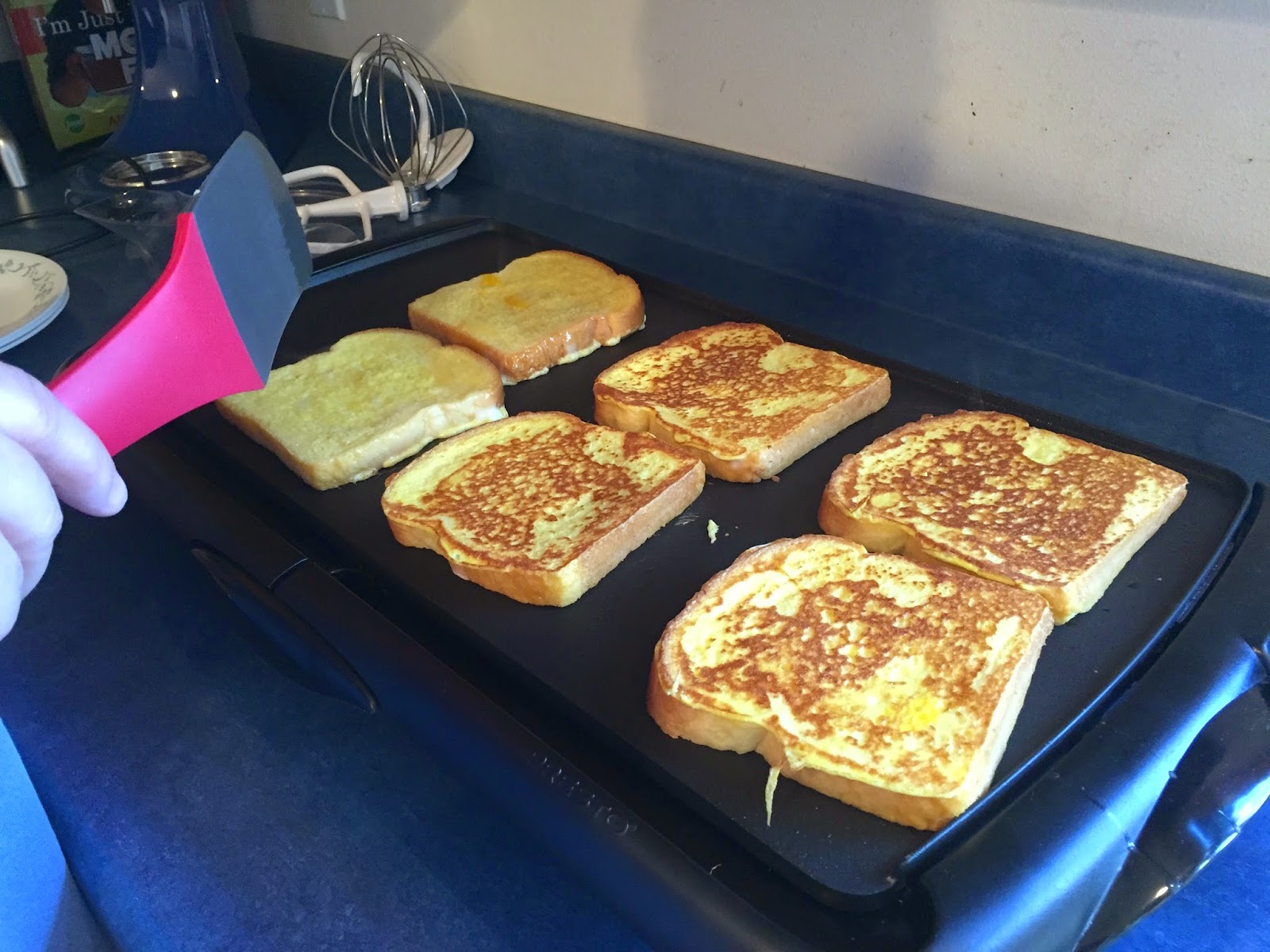

It's a nice way to start the day. And every chemo treatment is one step closer to "cured."
Along with autism comes a lot of food issues. This part of autism was not nearly as well understood when Alex was a toddler as it is today. Many (most?) individuals with autism have a restricted palette of foods that they eat. The issues may revolved around texture, color, smell or other concerns. It has always been difficult for Alex to try new foods. But spaghetti has always been a favorite.
Now spaghetti night has changed a bit. It's part of our new "chemo routine." We pick Alex up from his house on Wednesday, the night before chemo. We have spaghetti for dinner. I know that I can get him to eat well. It's sort of like carb-loading the night before a marathon. I also know that he isn't going to eat much for the two or three days after chemo, so I want to get him off to a good start.
So, we have spaghetti. Last night, spaghetti night was the night of LaVerne's funeral. I guess I was overtired and a bit distracted. I was wondering why the water wouldn't boil when I discovered that I never turned the burner on under the pasta pot. Well, I guess that's a problem. Then I burned two batches of garlic bread under the broiler. John managed to salvage part of the second batch and I gave up at that point. The spaghetti turned out well, though. Alex ate well, and we all crashed in front of reruns of Big Bang Theory.
The morning of chemo is French toast. It's a way to get an egg in Alex for the protein. He eats well in the morning the day of chemo. By lunch time, he may or may not be able to eat. Last time, he didn't eat all day. The time before, he ate lunch while getting his infusion and snacked throughout the day. We'll see what today brings.
John took over breakfast years ago. He doesn't have much of an interest in cooking, but he has become the breakfast king. So dad's French toast is the order of the day. The meals also provide comfort and routine and a bit of normalcy in what is our current life.
It's a nice way to start the day. And every chemo treatment is one step closer to "cured."
Thursday, April 16, 2015
Moments
Have you seen the wall art on Pinterest where people have a display of clocks, set to the time of their wedding and the births of their children? It's a sweet way to commemorate special moments. I don't have a display like that on my wall, but in my head and my heart I've had certain moments imprinted for years.
For many years I've thought of my life as "before autism" and "after autism." The date of Alex's autism diagnosis is a point in time where everything changed. I somehow thought it was the most important or significant event until, suddenly, it wasn't. The day of Alex's cancer diagnosis changed that. Another moment in time that changed everything.
Since then, since "the cancer day," I've done a lot of reflecting upon the idea of "moments." I've been thinking about how moments shape us and shape our lives. And how, more than the moments, it's really our choices we make when faced with those moments that define us.
Perhaps the first in a chain of moments was the moment I walked into the first debate team meeting of the year when I was a sophomore in high school. It was my second year in debate, so I walked in with at least a small degree of confidence. In addition to all of our returning team members, were some new kids who wanted to join the team. That was the day that I met John. He walked in and he appeared much more outgoing and confident than I felt. He wore a camera around his neck, and faux leather pants. (In 1978 those were actually pretty cool.) I didn't know that day that this was a moment that would change my life, yet I can remember it pretty clearly. I think of it whenever I walk by Mr. Rutter's social studies room, which hasn't been Mr. Rutter's social studies room in decades, in a school that isn't even a high school any more. (When we take our fourth graders to tour the middle school every spring, I point out the classroom as we walk by. "That's where I met Mr. Forster for the first time." The girls all go, "Awww...."
And of course I remember our wedding and the births of my children, but there are other everyday moments that stick out.
I can remember sitting in Jessica's bedroom, in our tiny home on Wilson Street, rocking her to sleep and singing Dan Fogelberg's "Another Auld Lang Syne." She was only a few weeks old. I vividly remember feeling like I needed to capture that moment and hold it in time. It's like the character Cam Janssen in the kids' mystery series. Cam says, "Click" and remembers exactly what she sees. I remember what Jessica looked like, what she smelled like, and what she felt like on my shoulder. "Click."
And I remember the day of Alex's autism diagnosis. The early childhood team came to our home for their assessment. We'd already had multiple assessments and phone consultations so the diagnosis on this day was a confirmation, not a surprise. But it was still a moment that changed everything. I remember the feeling of knowing I would have to become an expert about autism, and I didn't want to. I remember the fear of not knowing, and wishing I had a crystal ball to tell me everything would be okay. I didn't have a crystal ball. But I did have John. John who reminded me that nothing was changed. Alex was still our beautiful son. He reminded me that our job as parents was to take our children from where they were as far as they could go. He said that might look different for Alex, but it was still the same job. And we did become experts. But we also vowed that autism wouldn't define Alex and wouldn't define our family. And that we wouldn't become so obsessed with chasing miracles that we would give Alex the message that we were trying to fix him because he was broken. We never, ever wanted him to believe that he was not good enough, or less than. We found a way to live life and have joy. That was our choice.
I remember Alex's first communion and all the preparation. I remember my panic when we got to the end of mass and I didn't know what to do because we never practiced the end of mass. We practiced going in, and we had an "escape" plan that Father and the teachers knew about so we could take Alex out early if he needed to go. But he didn't need to go. He made it through the entire mass, and he received his sacrament, and then it was time to process out with the rest of the communicants. It seems silly now, but it had honestly never occurred to me we'd make it to the end, but we did.
And Jessica had many "moments." There were so many recitals and concerts and plays. She was involved, talented, and accomplished. And many of her "moments" were things that were too difficult for Alex to participate in. Sitting through a play or a recital or concert was impossible for much of their childhood. So Jessica had to learn at a young age whether the event was a "one parent" or "two parent" event. A "one parent" event was one that she was excited about but she could be content to have only of us attend and the other would stay home with Alex, or the three of us would attempt to attend and she would be okay if one of us had to leave with him. A "two parent" event was more special to her, and then we would make arrangements for Alex. It was always a balancing act. Our fear was never that Jess would demand too much but the opposite. We always feared that she would put her brother's needs before her own and not tell us her true desires.
Now there's the cancer diagnosis. Another life moment that changes everything. You get the news and the whole world looks different, feels different, sounds different, smells different. I feel sheepish for thinking that autism was the defining moment of our lives. Autism changed the direction; cancer really does change everything.
So now you have a choice. We didn't choose cancer, and we can't control the outcome, but we can put forth our best effort. We can help Alex and support him. We can literally and figuratively hold his hand through every treatment. Once again, we have to become experts in an area we didn't think we'd have to know anything about. We know so many words now that we didn't know three months ago. But we're also lucky. Hodgkins is a very treatable cancer with a high cure rate. Alex is young and was very healthy before cancer. He has a support system that won't give up on him. Now there's a point in time that's "before cancer," but I know that we'll have a point in time that's "after cancer." We have much to look forward to. Jessica and Rusty's wedding. And the family celebrations that Jessica and I are already planning for "after cancer."
I wonder how many of those clocks I need on my wall?
For many years I've thought of my life as "before autism" and "after autism." The date of Alex's autism diagnosis is a point in time where everything changed. I somehow thought it was the most important or significant event until, suddenly, it wasn't. The day of Alex's cancer diagnosis changed that. Another moment in time that changed everything.
Since then, since "the cancer day," I've done a lot of reflecting upon the idea of "moments." I've been thinking about how moments shape us and shape our lives. And how, more than the moments, it's really our choices we make when faced with those moments that define us.
Perhaps the first in a chain of moments was the moment I walked into the first debate team meeting of the year when I was a sophomore in high school. It was my second year in debate, so I walked in with at least a small degree of confidence. In addition to all of our returning team members, were some new kids who wanted to join the team. That was the day that I met John. He walked in and he appeared much more outgoing and confident than I felt. He wore a camera around his neck, and faux leather pants. (In 1978 those were actually pretty cool.) I didn't know that day that this was a moment that would change my life, yet I can remember it pretty clearly. I think of it whenever I walk by Mr. Rutter's social studies room, which hasn't been Mr. Rutter's social studies room in decades, in a school that isn't even a high school any more. (When we take our fourth graders to tour the middle school every spring, I point out the classroom as we walk by. "That's where I met Mr. Forster for the first time." The girls all go, "Awww...."
And of course I remember our wedding and the births of my children, but there are other everyday moments that stick out.
I can remember sitting in Jessica's bedroom, in our tiny home on Wilson Street, rocking her to sleep and singing Dan Fogelberg's "Another Auld Lang Syne." She was only a few weeks old. I vividly remember feeling like I needed to capture that moment and hold it in time. It's like the character Cam Janssen in the kids' mystery series. Cam says, "Click" and remembers exactly what she sees. I remember what Jessica looked like, what she smelled like, and what she felt like on my shoulder. "Click."
And I remember the day of Alex's autism diagnosis. The early childhood team came to our home for their assessment. We'd already had multiple assessments and phone consultations so the diagnosis on this day was a confirmation, not a surprise. But it was still a moment that changed everything. I remember the feeling of knowing I would have to become an expert about autism, and I didn't want to. I remember the fear of not knowing, and wishing I had a crystal ball to tell me everything would be okay. I didn't have a crystal ball. But I did have John. John who reminded me that nothing was changed. Alex was still our beautiful son. He reminded me that our job as parents was to take our children from where they were as far as they could go. He said that might look different for Alex, but it was still the same job. And we did become experts. But we also vowed that autism wouldn't define Alex and wouldn't define our family. And that we wouldn't become so obsessed with chasing miracles that we would give Alex the message that we were trying to fix him because he was broken. We never, ever wanted him to believe that he was not good enough, or less than. We found a way to live life and have joy. That was our choice.
I remember Alex's first communion and all the preparation. I remember my panic when we got to the end of mass and I didn't know what to do because we never practiced the end of mass. We practiced going in, and we had an "escape" plan that Father and the teachers knew about so we could take Alex out early if he needed to go. But he didn't need to go. He made it through the entire mass, and he received his sacrament, and then it was time to process out with the rest of the communicants. It seems silly now, but it had honestly never occurred to me we'd make it to the end, but we did.
And Jessica had many "moments." There were so many recitals and concerts and plays. She was involved, talented, and accomplished. And many of her "moments" were things that were too difficult for Alex to participate in. Sitting through a play or a recital or concert was impossible for much of their childhood. So Jessica had to learn at a young age whether the event was a "one parent" or "two parent" event. A "one parent" event was one that she was excited about but she could be content to have only of us attend and the other would stay home with Alex, or the three of us would attempt to attend and she would be okay if one of us had to leave with him. A "two parent" event was more special to her, and then we would make arrangements for Alex. It was always a balancing act. Our fear was never that Jess would demand too much but the opposite. We always feared that she would put her brother's needs before her own and not tell us her true desires.
Now there's the cancer diagnosis. Another life moment that changes everything. You get the news and the whole world looks different, feels different, sounds different, smells different. I feel sheepish for thinking that autism was the defining moment of our lives. Autism changed the direction; cancer really does change everything.
So now you have a choice. We didn't choose cancer, and we can't control the outcome, but we can put forth our best effort. We can help Alex and support him. We can literally and figuratively hold his hand through every treatment. Once again, we have to become experts in an area we didn't think we'd have to know anything about. We know so many words now that we didn't know three months ago. But we're also lucky. Hodgkins is a very treatable cancer with a high cure rate. Alex is young and was very healthy before cancer. He has a support system that won't give up on him. Now there's a point in time that's "before cancer," but I know that we'll have a point in time that's "after cancer." We have much to look forward to. Jessica and Rusty's wedding. And the family celebrations that Jessica and I are already planning for "after cancer."
I wonder how many of those clocks I need on my wall?
Tuesday, April 14, 2015
Laughter in the Waiting Room
We spend a lot of time in waiting rooms these days. I remember that waiting for doctor's appointments was truly excruciating when Alex was younger. As a toddler, I would work to keep him distracted and within arm's reach. He had no fear and would wander anywhere, so I could never be one of those parents who read a magazine and assumed their child would remain nearby. In the waiting room of our family doctor, there was a play area for the little ones. It held a big toy box with lots of donated toys. Jessica and Alex loved those toys! I cringe to think about it now. All the sick children playing with the same germ-infested toys. What were we thinking? But the toys kept them occupied.
After the toddler stage, he became more anxious about waiting at the doctor's office. By the time he was about 9 or 10 he would have a full-blown panic attack. His pulse would race, his blood pressure would rise, and he'd develop a rash over his face, neck, and arms. I'd sing to him, read to him, play games with him - anything to calm and distract him.
John and I used to say, "What would we do if Alex ever had a serious medical issue? How would he handle it? How would we cope?"
At about the age of 13 he had a bump on his knee. It was a benign bone tumour called an osteochondroma. He had it removed in outpatient surgery. He did very well. The doctor recommended crutches or a walker for post-surgery. Even though insurance would pay, I didn't want to buy a device that I wasn't sure Alex would use. Our friend, who is a PT, was able to borrow a walker for him. When they were getting ready to release him a few hours after his surgery, we tried to show him how to use the walker so that he wouldn't have to put all his weight on the leg he'd just had operated on. I demonstrated. Alex watched. Then he took the walker, lifted it up, and carried it across the hospital room while he walked. So much for that experiment. Good thing we didn't buy one.
When Alex was 19 he had to have his wisdom teeth out. We were hoping to avoid that, too, but he got an infected tooth while we were in California visiting Jessica. Jeanne was staying with him and called us because he had a red, inflamed cheek. She got antibiotics from the dentist and we made an appointment with an oral surgeon for as soon as we got back. The oral surgeon did the surgery under general anesthesia. It went well.
Thank goodness, we thought. These things went well. Just enough so that Alex has some experience under his belt, but hopefully nothing worse will happen.
Don't mock the universe. It never goes well.
In the last three months there have been so many doctors and doctor's visits, so many waiting rooms, and so many facilities. We cope with laughter.
A dark sense of humour can be really helpful. (A gentleman got on the elevator after us last week. "What floor?" I asked. "Four," he replied. "That's good, " I said. "We're going to two, and you sure don't want to go to two if you can help it. That's oncology." He just pretended I wasn't there.)
We travel in packs with Alex. A couple of times it's just been John or I with Alex at an appointment, but usually it's both of us and perhaps one or more other people. Sometimes it's Jessica, or someone from Alex's house, or Allison. Last time Jessica was home, we all went to Alex's blood draw. There were five of us, gathered in the corner of the waiting room. I don't remember what we were talking about, but we were loud and laughing and just being kind of ridiculous.
At chemo last week, John and Allison were having a debate about something. There was good-natured, sibling bickering going on. They're going back and forth, and laughing, and arguing. The nurses' station is right outside our door, and I see them peering in, smiling and laughing at us. I don't think they know what to make of us.
Laughing is our way of coping. Alex has become really good at waiting. He is patient. He is usually anxious, but he works so hard. I don't think most people understand what it takes out of him to go through these appointments and procedures. Sometimes there's a lot of rocking and some vocalizing. We remind him not to get too loud but it is what it is. I don't care what people think about his rocking or the sounds he makes. He's coping the best that he can. He's coping with waiting, with uncertainty, and with cancer. And he's coping with a goofy family; maybe that's the hardest thing of all.
After the toddler stage, he became more anxious about waiting at the doctor's office. By the time he was about 9 or 10 he would have a full-blown panic attack. His pulse would race, his blood pressure would rise, and he'd develop a rash over his face, neck, and arms. I'd sing to him, read to him, play games with him - anything to calm and distract him.
John and I used to say, "What would we do if Alex ever had a serious medical issue? How would he handle it? How would we cope?"
At about the age of 13 he had a bump on his knee. It was a benign bone tumour called an osteochondroma. He had it removed in outpatient surgery. He did very well. The doctor recommended crutches or a walker for post-surgery. Even though insurance would pay, I didn't want to buy a device that I wasn't sure Alex would use. Our friend, who is a PT, was able to borrow a walker for him. When they were getting ready to release him a few hours after his surgery, we tried to show him how to use the walker so that he wouldn't have to put all his weight on the leg he'd just had operated on. I demonstrated. Alex watched. Then he took the walker, lifted it up, and carried it across the hospital room while he walked. So much for that experiment. Good thing we didn't buy one.
When Alex was 19 he had to have his wisdom teeth out. We were hoping to avoid that, too, but he got an infected tooth while we were in California visiting Jessica. Jeanne was staying with him and called us because he had a red, inflamed cheek. She got antibiotics from the dentist and we made an appointment with an oral surgeon for as soon as we got back. The oral surgeon did the surgery under general anesthesia. It went well.
Thank goodness, we thought. These things went well. Just enough so that Alex has some experience under his belt, but hopefully nothing worse will happen.
Don't mock the universe. It never goes well.
In the last three months there have been so many doctors and doctor's visits, so many waiting rooms, and so many facilities. We cope with laughter.
A dark sense of humour can be really helpful. (A gentleman got on the elevator after us last week. "What floor?" I asked. "Four," he replied. "That's good, " I said. "We're going to two, and you sure don't want to go to two if you can help it. That's oncology." He just pretended I wasn't there.)
We travel in packs with Alex. A couple of times it's just been John or I with Alex at an appointment, but usually it's both of us and perhaps one or more other people. Sometimes it's Jessica, or someone from Alex's house, or Allison. Last time Jessica was home, we all went to Alex's blood draw. There were five of us, gathered in the corner of the waiting room. I don't remember what we were talking about, but we were loud and laughing and just being kind of ridiculous.
At chemo last week, John and Allison were having a debate about something. There was good-natured, sibling bickering going on. They're going back and forth, and laughing, and arguing. The nurses' station is right outside our door, and I see them peering in, smiling and laughing at us. I don't think they know what to make of us.
Laughing is our way of coping. Alex has become really good at waiting. He is patient. He is usually anxious, but he works so hard. I don't think most people understand what it takes out of him to go through these appointments and procedures. Sometimes there's a lot of rocking and some vocalizing. We remind him not to get too loud but it is what it is. I don't care what people think about his rocking or the sounds he makes. He's coping the best that he can. He's coping with waiting, with uncertainty, and with cancer. And he's coping with a goofy family; maybe that's the hardest thing of all.
Thursday, April 9, 2015
We've Got This!
Jessica and Alex have always shared a special bond. Jessica was just 19 1/2 months old when we brought her brother home. She thought that bringing a baby home for her was the best idea we'd ever had. She never seemed to have a moment of jealousy or apprehension. She didn't ask me to take him back. I take absolutely no credit for this; it was just her nature. She was excited throughout my pregnancy and excited about the new baby. She tried to mother him right away. We had to stop her from trying to feed banana slices to a newborn. She still used a pacifier, and she would trade with her brother. Grabbing her own from her mouth, then his, and switching. Not at all hygenic, I know, but it was so darn adorable.
Alex's autism was diagnosed when she was three. She's told me since that she doesn't remember this time in our lives. There is no "before" and "after" the diagnosis like there is for her dad and me. There's just Alex.
We tried hard not to rely to much on her for help with her brother. It was difficult, always, to hold her back. Her instinct was always to mother him.


At ten, she asked my mother if Alex would ever go to college. Grandma told her gently that no, he probably would never go to college. "That's okay," Jess replied. "I'll go to college, and then when I'm done he'll come and live with me."
Throughout Alex's life, Jessica has been beside him, guiding him and protecting him. Despite our best efforts to shield her from taking on too much responsibility, we were powerless to stop her.
When Alex graduated from high school, we planned and orchestrated a private ceremony complete with a processional, music, speakers, school board member giving him his diploma, and a slide show. Jessica escorted her brother down the aisle at the beginning of the ceremony. She and John's cousin, Lynn, sang "For Good" from Wicked as the closing song. There wasn't a dry eye in the house.

At nineteen, I faxed guardianship papers to her in Boston. We were completing the legal guardianship process for her brother, with her dad and me as his guardians. Part of the process was to have her named as back-up guardian, should something happen to both of us. Late that night, I emailed her. I had gotten caught up in all of the details, red tape, and delays in the guardianship process. I forgot, for just a moment, that other nineteen year olds do not sign legal papers to become their sibling's guardian in case something happens to their parents. I apologized in the email, and thanked her for always being there for her brother.
I've always been pleased that she felt she could go far away to school, and far away for her job. I'm glad that she didn't feel she needed to stay close by because of her brother's disability. The truth is, the distance isn't so bad. We talk almost daily, and we travel frequently. Alex doesn't travel long distances easily, so she comes here to see him. At any rate, despite the geographical distance, Jess and her brother remain extremely close.
So as soon as we got the news about Alex's cancer, I knew I was going to have to call Jessica at work, 2,200 miles away, and give her the devastating news. My heart had just been broken by learning that my son had cancer. Now I had to tell his sister. More heartbreak.
I called her work phone, which I never do. She answered and the tone of her voice told me she was wary about the number on her caller id. I had called from her dad's phone, so she was somewhat surprised to hear my voice. I honestly don't remember the exact conversation, but it went something like this:
"Hello?"
"It's mom. We were at Alex's doctor's appointment. It's bad."
Silence.
"He has cancer."
I'm crying by this point, and she starts crying, too. At work. Alone. Did I mention she was 2,200 miles away?
"I want to come home."
"We'll figure something out," I start to say, and I'm trying to be practical. I hadn't thought about this. We've known for less than an hour that Alex had cancer, so I was still in a fog. She hung up the phone before I could say much more. She called back about 10 minutes later.
"I found a flight. I get into Milwaukee at 10:05. I have to go talk to my boss."
And that was that. Jessica spoke with her cube mates and her boss, and left her office. She went home and packed a bag, and drove to LAX. John and I went to our respective works and talked with our bosses. I had texted my principal as soon as I had gotten the news. I'd been off work for a week for Alex's surgery, and was due back at school the following day. My principal and my fourth grade team all knew I was getting biopsy results that morning. I cried in my principal's office and tried to figure out a plan. We had no plan yet, and wouldn't get one for more that a week.
John and I drove to Milwaukee and picked Jessica up. We had returned Alex to his group home that morning, after the appointment. The next day, the three of us picked Alex up for lunch. Jessica was with us for the first oncology appointment. She was with us as we all tried to process what was happening. Together, we were unified. Together, things were a little less terrifying.
"We've got this," we told each other. And the funny thing is, we knew it was true. We didn't yet have any idea what we meant, but we knew that anything we had to face, we could face together.
The four of us clung together, figuratively at least, for that weekend. We also laughed and talked about the wedding and non-cancer things. We tried to be just "us." The before-cancer us. And it worked, at least a little. It worked enough, anyway, to get us through those first days.
By the time Jess went back to California on Monday, we were less in shock and ready for a fight. When Jess booked her flight and was coming home, I told myself she needed to do it for her. She needed to see her brother and she needed to be here. When she left to go back home, I realized we needed her to be here. We needed her every bit as much as she needed us.
Alex's autism was diagnosed when she was three. She's told me since that she doesn't remember this time in our lives. There is no "before" and "after" the diagnosis like there is for her dad and me. There's just Alex.
We tried hard not to rely to much on her for help with her brother. It was difficult, always, to hold her back. Her instinct was always to mother him.
At ten, she asked my mother if Alex would ever go to college. Grandma told her gently that no, he probably would never go to college. "That's okay," Jess replied. "I'll go to college, and then when I'm done he'll come and live with me."
Throughout Alex's life, Jessica has been beside him, guiding him and protecting him. Despite our best efforts to shield her from taking on too much responsibility, we were powerless to stop her.
When Alex graduated from high school, we planned and orchestrated a private ceremony complete with a processional, music, speakers, school board member giving him his diploma, and a slide show. Jessica escorted her brother down the aisle at the beginning of the ceremony. She and John's cousin, Lynn, sang "For Good" from Wicked as the closing song. There wasn't a dry eye in the house.
At nineteen, I faxed guardianship papers to her in Boston. We were completing the legal guardianship process for her brother, with her dad and me as his guardians. Part of the process was to have her named as back-up guardian, should something happen to both of us. Late that night, I emailed her. I had gotten caught up in all of the details, red tape, and delays in the guardianship process. I forgot, for just a moment, that other nineteen year olds do not sign legal papers to become their sibling's guardian in case something happens to their parents. I apologized in the email, and thanked her for always being there for her brother.
I've always been pleased that she felt she could go far away to school, and far away for her job. I'm glad that she didn't feel she needed to stay close by because of her brother's disability. The truth is, the distance isn't so bad. We talk almost daily, and we travel frequently. Alex doesn't travel long distances easily, so she comes here to see him. At any rate, despite the geographical distance, Jess and her brother remain extremely close.
So as soon as we got the news about Alex's cancer, I knew I was going to have to call Jessica at work, 2,200 miles away, and give her the devastating news. My heart had just been broken by learning that my son had cancer. Now I had to tell his sister. More heartbreak.
I called her work phone, which I never do. She answered and the tone of her voice told me she was wary about the number on her caller id. I had called from her dad's phone, so she was somewhat surprised to hear my voice. I honestly don't remember the exact conversation, but it went something like this:
"Hello?"
"It's mom. We were at Alex's doctor's appointment. It's bad."
Silence.
"He has cancer."
I'm crying by this point, and she starts crying, too. At work. Alone. Did I mention she was 2,200 miles away?
"I want to come home."
"We'll figure something out," I start to say, and I'm trying to be practical. I hadn't thought about this. We've known for less than an hour that Alex had cancer, so I was still in a fog. She hung up the phone before I could say much more. She called back about 10 minutes later.
"I found a flight. I get into Milwaukee at 10:05. I have to go talk to my boss."
And that was that. Jessica spoke with her cube mates and her boss, and left her office. She went home and packed a bag, and drove to LAX. John and I went to our respective works and talked with our bosses. I had texted my principal as soon as I had gotten the news. I'd been off work for a week for Alex's surgery, and was due back at school the following day. My principal and my fourth grade team all knew I was getting biopsy results that morning. I cried in my principal's office and tried to figure out a plan. We had no plan yet, and wouldn't get one for more that a week.
John and I drove to Milwaukee and picked Jessica up. We had returned Alex to his group home that morning, after the appointment. The next day, the three of us picked Alex up for lunch. Jessica was with us for the first oncology appointment. She was with us as we all tried to process what was happening. Together, we were unified. Together, things were a little less terrifying.
"We've got this," we told each other. And the funny thing is, we knew it was true. We didn't yet have any idea what we meant, but we knew that anything we had to face, we could face together.
The four of us clung together, figuratively at least, for that weekend. We also laughed and talked about the wedding and non-cancer things. We tried to be just "us." The before-cancer us. And it worked, at least a little. It worked enough, anyway, to get us through those first days.
By the time Jess went back to California on Monday, we were less in shock and ready for a fight. When Jess booked her flight and was coming home, I told myself she needed to do it for her. She needed to see her brother and she needed to be here. When she left to go back home, I realized we needed her to be here. We needed her every bit as much as she needed us.
Subscribe to:
Posts (Atom)