We had a nice, quiet Father's Day. Jessica called her dad in the morning to wish him a Happy Father's Day. We picked Alex up in the afternoon to spend a few hours and have some dinner. He wasn't feeling very well. They've warned us that the cumulative effect of the chemo will likely catch up with him. He was tired and just not himself. My dad used to describe days like this as "feeling kind of punk." John and I wondered if Alex was experiencing bone pain and/or discomfort from the Neulasta. That is a common side effect and, of course, Alex can't tell us. All we can do is observe. So we gave him some Advil, picked up a pizza, and hunkered down on the couch for a marathon of Myth Busters. We also decided to have an impromptu sleepover and keep Alex with us for the night. Except for the part where Alex didn't feel well, and that the reason was cancer, it was a nice Father's Day. Our lives never lack for being busy, so quiet family time is always appreciated.
I also did a lot of reflecting on the day. (Really, it doesn't take much to get me to reflect. I tend toward being an "over-thinker," and I get quite sappy at Hallmark commercials, kids' books, and dog videos on social media. I recently learned that there's a website called "Does the Dog Die?" to save people such as myself from being blind-sided at movies.)
Anyway, I was thinking about the meaning of Father's Day, and how the day brings different meaning and emotions to different people. I thought about my friend Kate, marking the first Father's Day without the love of her life and father of her children, only a couple of short weeks after his death. I thought about her husband, Jeremy's, parents, marking Father's Day without their beloved son. I thought about my friend Kaitlyn, celebrating what may be her dad's last Father's Day (have I said lately that cancer sucks?). I thought about missing my own dad, who I lost when I was only 31. And I thought about many family members and friends who have lost dads, or have broken relationships with their dads, or have father-figures for themselves or their children that they are so blessed to have in their lives. It isn't an easy day for many people. I was wishing I had a way to make the day better for the people I care about for whom the day was painful.
With so many complicated feeling swirling around, I also thought about the most important dad in my life - my husband. Being a dad is a big responsibility. Being a special needs dad, and then a dad of a critically ill child (even an adult child) adds on special layers. John has never, ever been afraid to jump right in and get his hands dirty as a dad. I'm not sure he had ever even held an infant before the nurses placed Jessica in his arms, yet from that first moment he never looked back. I think he would say being Jessica and Alex's dad is the best role of his life.
When we realized there was something "different" about Alex and began pursuing an autism diagnosis, John was there every step of the way. The professionals were kind and complimentary to me, but were genuinely surprised at the level of John's involvement. More than one professional made comments about how hard it must be for a dad to accept such a diagnosis in his only son. Don't get me wrong, we grieved plenty for lost opportunity, but our son was still there, and we were devoted to him. The implication that John would love him less somehow, or view Alex as "less than," did not sit well with Papa Bear, let me tell you.
Since Alex's cancer diagnosis, I've been asked many times if I was still working (I did keep working throughout the school year, at least when I could), but John doesn't get asked that question. On a pragmatic level, if one of us had to take an extended period of time off, it would make financial sense for it to be me. I earn less. On a which parent is more capable level, John is every bit as capable as I am.
When Alex was first diagnosed with autism and was not yet in school, we took him to therapy together. The majority of appointments throughout Alex's life have been done together. When the kids were little and got sick, John never had a problem being the one to stay home with them. He's held plenty a puke bucket in front of a sick kiddo and spent the entire day on the couch with a sick infant/toddler/child on his lap.
When Alex had surgery in January, we both stayed overnight with him at the hospital. Neither one of us wanted to be the one to stay at home. John was supposed to be in Arizona for three weeks in January. He called the client and explained that he couldn't come. The trip was deferred. He was supposed to go in February, but then there was the cancer diagnosis, and staging the cancer, and beginning treatment. The trip was deferred again, and ultimately didn't take place. The client was understanding. John's boss and co-workers have been fantastic. Both of our employers have been supportive and amazing. Alex's group home has been amazing. They have stepped up. If not for them, we couldn't have worked as much as we did.
John and I have been at every chemo treatment, together. We didn't even plan it that way at first. I think initially we thought we'd take turns, or maybe I would take more time off. It was too frightening at first. We felt we both needed to be at every appointment. Now it's to the point where neither one of us wants to miss anything. We want Alex to know that we're there for him, no matter what.
So on Father's Day, I watched John sitting next to Alex on the couch, stroking Alex's head as he slept. I saw him trying to protect his son, knowing that if there was a way for him to take this cancer himself to spare his son no power on earth would be able to stop him. And I thought about how lucky I am. Alex's prognosis is hopeful. And somehow I was smart enough, or dumb enough, or lucky enough to fall in love at the age of 16 with a boy who would become the man I have shared every important milestone of my life with. How lucky and I that this man loves me, and that we created a family together. How lucky am I.
Wednesday, June 24, 2015


Saturday, June 13, 2015
Push Me, Pull You
I took a nap yesterday, and I dreamt that Alex and I were walking through town. Along the way, we stopped at a lemonade stand. The girl selling lemonade was about Alex's age. I didn't know her, but they knew each other. He looked at her, and spoke. A complete sentence. Clear as could be. I could hear his voice in my dream. It shocked me so much I immediately woke up, and as soon as I was awake I wished I was asleep again so I could hear what his voice sounded like.
There isn't a day that goes by that I don't wish I could hear Alex's voice. I want to know what he's thinking. What he's feeling. I want to know if I'm guessing right. I'd even be happy to know that I've been guessing wrong, if I could hear it from him. "Mom, what were you thinking?"
I've learned to listen differently. I've learned to watch and read signals. Sometimes, when people interpret his sounds and actions as happy, we believe we know differently. It may even begin as happy, but it slides into anxiety and overstimulation. John, Jessica, and I have learned to read him. There are others who can read him, too, but it takes practice and a real commitment to paying attention.
We've learned, I hope, to pay attention. We've learned a lot in the past 25 years. Parenting for anyone is a journey and there are mistakes and milestones. Parenting more than one child requires a lot of juggling and balancing for all families and we all have our own unique sets of challenges. In our case, parenting Alex and Jessica makes me think of the "Push Me, Pull You" from Dr. Doolittle. Often what they each needed was in direct contrast to each other. The challenge to give each one what they needed, when they needed it, was always a goal but sometimes it was harder to achieve than others. Each one pushing, pulling against the other like the fictional creature.
It wasn't just that Alex needed a lot, or that Alex couldn't do the things that Jessica could. Alex needed therapy and intensive intervention and, in those days, the outside help we received was minimal. From his diagnosis until he started school at age 3, we got about an hour of therapy a week. He started early childhood at age 3, which was half days, four days a week. The rest was up to us. Jessica started music lessons at age four, and performing in theatre at age seven. Alex wasn't the kind of kid you could drag along to a music lesson or play practice. You could take him in the car to drop her off, but even waiting for a pick up was often problematic. John and I learned early to divide and conquer. We were also able to rely on some family members to help with transportation, and we started hiring caregivers who would be able to watch one when we needed to be involved with the other.
And we learned what we could do as a family, and what we needed to do separately for each one.
Now that I'm older, with a "few more trips around the sun" as John likes to say, I would cut my younger self a lot more slack. What's the big deal if the younger sibling doesn't want to go to the recital, I would say now. But back then, it was difficult. For many years, as I sat in the audience watching Jessica perform, I felt guilty about leaving Alex behind. It hurt that he couldn't be there with us. Maybe my angst was needless. If he could have spoken, maybe he would have said, "Geez, mom, why would I want to go?"
We learned what we loved to do together - baking cookies, coloring Easter eggs, watching movies, going for rides, swimming, roller coasters and museums. We travelled together. We went through museums at Alex's pace. We visited Disney and rode roller coasters. We've been to Mount Rushmore, Washington DC and Boston. We made memories as a family.
When we went to Disney when Alex was seven, he had finally learned to say "no." He pronounced it "whoa" and would shake his own head back and forth, but he would also grab the face of the person he was talking to and she their head. We'd inadvertently built that in as part of the response through years of trying to teach him how to say no by adults touching his chin and shaking his head back and forth. He thought that was part of the response. We drove to Disney, and any time Alex heard someone (whether he knew them or not) say the word "car" he would grab my face, or his dad's or his sister's, and emphatically say "whoa." He did not want to go home! We were thrilled with his communication, and he gave us a good chuckle.
We knew, and Jess learned at a young age, that traveling with Alex meant the trip had to work around his needs and what he was able to do. Roller coasters - yes; lining up and waiting for parades - no. Being together as a family was the most important thing. Watching Alex enjoy new experiences was magical for all of us. When he was overwhelmed or struggled, we all just wanted to make him feel better.
Within every trip, John and I would trade off with Jessica. At some point, when Alex needed a break, one of us would stay back with him and the other would do something special with Jessica. We would do something that she wanted to that Alex was unable to do.
Starting when Jess was about six, we began traveling alone with her. At least one weekend a year, we would take her someplace that she wanted to go - a weekend in Milwaukee, or Chicago, or New York. Most trips were pretty simple; some, a bit more involved. We would visit museums more slowly, and go to shows and restaurants that Alex would not have enjoyed.
It wasn't easy to figure all this out, and we didn't always get it right. Sometimes the compromises were easy, but sometimes they weren't. We took Alex to visit Jess at MIT in Boston. It was a great trip, and Alex did well. But traveling takes a lot out of him. In some ways, it's gotten harder as he's gotten older. I think when he was younger he was more oblivious to the world around him. He can't shut things out as easily now. He was done with that trip before we were planning to leave. We decided to leave a day early. It was a difficult decision, and disappointing to all of us.
Without Alex having language, we don't have the ability to negotiate in these situations. We can't ask him if he wants to leave, or if he wants to stay even though it's difficult for him. We're always guessing. We're always trying to decide if the "stretch" is worth it - what is he getting out of this, is it what he wants, is it good for him, or is it too much? We don't want Alex's world to get to small, but we want to respect his needs and wishes.
Holidays and family events have always been tricky as well. Alex was always easily overwhelmed by the excitement, energy, and change in routine. Jess loved it all. Lots of cousins? Great! Tons of people? Fantastic. We had to figure out a system for these as well. John and I always had a plan - who would stay with Jess, and who would take Alex home early. We often went places in two cars, so one of us could leave with Alex if we had to. Every event had a back up plan. If it was an event that we felt we both needed to stay for, then we had someone else on "stand by" for Alex.
When the wedding planning started, we knew we had to have a back-up plan. We all wanted Alex to be a part of it, but knew that he had to have an "escape" whenever he needed. So we made a plan with one of Alex's caregivers from his group home. We had a plan we felt good about. Then he got sick. We didn't know how that would impact his ability to participate in and enjoy (tolerate?) the day. Then we realized that the wedding fell on a chemo week. We knew that there was a real possibility that Alex wouldn't feel well enough to attend. We made a plan, and prepared ourselves for whatever he would be able to do. Jess and Rusty came home from California for the wedding on Wednesday. We all went to chemo with Alex on Thursday. Alex should have spent the next two days in bed. Instead, he went to a wedding pig roast. He was anxious, but he stayed for over an hour. (That may not sound like much to the casual observer but, trust me, that was a big deal; even for a healthy Alex much less one who had just had chemo 24 hours before).
The day of the wedding, he showed up looking handsome and healthy, and with a big smile on his face. He walked me down the aisle. He beamed at his sister when she took her place by Rusty's side. (And he apparently stuck out his tongue at Rusty.) Just like the rest of us, he didn't stop smiling all afternoon. As he took his last bite of his dinner, it all caught up with him. The color left his face, and he suddenly looked like he would fall asleep sitting up. His caregivers quickly finished eating, and took him home. Alex had exceeded all of our expectations and, by all indications, looked like he had a great time. We couldn't have asked for more even if he hadn't been sick. He always seems to know when it's time to step up, and he certainly did that day.

So now when I think of that fictional Push Me Pull You, I don't see that creature that is tugging at each other, unable to move. I see that creature learning what the other half needs, and learning how to move together. Each one learns to give when the other needs it. At the end of the day, I guess that's the lesson that every family needs to learn.
Monday, June 8, 2015
Circle of Life...
Cue the Lion King music. Or my other thought for a title was Dicken's "It was the best of times, it was the worst of times...."
I'd like something more clever, but I'm far too exhausted after the last five days. We've experienced glorious highs, devastating lows, and everything in between. Jess and Rusty got married. Alex had chemo. A friend died tragically.
First, the wedding. It was glorious - absolutely perfect. When the daughter you adore is about the marry the man you think is perfect for her in every way, how can it be anything but perfect? The venue was the EAA Museum in Oshkosh, WI. That location was chosen before the groom was even on the radar. Jessica was never the little girl making tons of future wedding plans except for one thing - sometime long ago, I don't even remember when, it was decided that her "someday" wedding would be at the museum. She's been visiting this museum since her daddy pushed her in a stroller, an she hasn't missed attending AirVenture since she was seven. This little girl who grew up to be a pilot and an aeronautical engineer. Where else could she get married? So when Rusty proposed and wedding planning began in earnest, we never considered another venue. Rusty is not a pilot, but he is a history buff, a museum buff, and adores his Jessica, so he was on board right away.

Wedding Photo by Jenna Kutcher: wwww.jennakutcher.com.
Like every wedding, the last months have been filled with many details. We planned an entire "wedding weekend" to celebrate since many guests were traveling long distances. A Welcome BBQ was planned - a Wisconsin spanferkel. John's band agreed to play at the BBQ, and they practiced a few songs with Jess so she could sing at the party. The theme of WWII Aviation was carried out in every detail - from the gift card box, to table decor, to the clothing and everything in between. Jess spent hours and hours making sure everything was just right. Each guest table also had a QR code with a link to the history of their airplane or code-breaking location. They married on Rusty's grandparents' 62nd wedding anniversary (also the anniversary of D-Day), our musical group, Relativity, sang the same processional and recessional that was sung for our wedding, she wore her mother-in-law's veil, the groomsman wore special cuff links (Dr. Who for dad, Harry Potter for Alex, super heros for Rusty and the groomsmen), and on and on.
It was magical.
A particular highlight was Alex's involvement in the day. We always knew Alex participating in his sister's wedding would be a challenge. Crowds and big events are challenging for him, even under the best of circumstances. But now he's sick. We had already planned to have someone from his group home bring him to the events. Then we realized that wedding week was also chemo week. We considered altering his chemo schedule, but two doctors (without knowing anything about the wedding) advised us to not interfere with the chemo schedule, no matter what. It is not hyperbole to say his life is on the line. So we had chemo on Thursday, and Alex attended the BBQ Friday and the wedding Saturday. Typically, he would have spent those two days after chemo in bed. He did well at the BBQ, but he was pretty anxious. He stayed about an hour, and wasn't interested in eating and didn't do a lot of mingling. But he came, and he hugged his sister and seemed pretty happy.
Saturday he came and we did family pictures before the ceremony. We wanted to make sure we got some photos in case he couldn't stay. He ended up staying until after dinner. He smiled, enjoyed himself, and was relaxed. He ate three plates of spaghetti at dinner. (We had a buffet of multiple stations. The pasta station was selected with Alex in mind.) As he finished that last bite, he looked like he hit a wall. His color faded, and he looked exhausted. It was time to go. We were hoping he would stay for an hour, maybe two. He lasted four hours, and made it through the important events.


The day before the BBQ was chemo day. Jess and Rusty came along to chemo. Jessica held her brother's hand and spoke soothingly to him while it took an hour and seven tries to get his IV started. (Once they got it going, the rest of the day went pretty smoothly. It usually only takes one or two picks; Alex's veins would just not cooperate this week.) We hung out as a family for the day in the tiny exam room we use for each chemo. Jess and I filled out the escort cards for the table assignments. Rusty got more bonding time with this crazy family he's married in to. Part of me feels sad that it was a chemo week, but part of me is actually grateful because it has been so difficult for Jessica to be far away during this time. It felt good to be together at a time we needed each other.
In addition to all of these things going on, we lost a friend on Tuesday. I got a text alert to my phone that a small plane has crashed at Oshkosh. My heart stopped. We have so many friends that fly at that airport. Moments later, the next alert said it might be a Sonex. John and I were on our way to do some wedding preparations. We both felt sick. The names of all our friends that it could be started going through our minds. I sent a couple of texts; I got responses, but didn't know yet any details. The aviation world is a close knit one, and the connections keeping loop around in amazing ways. Sonex is based in Oshkosh, yet Jessica works with one of the designers of the aircraft out in California. So, while we were waiting for word here, the call came from Jessica with the news we were dreading. She called to tell us Jeremy had died in the crash. It wasn't until the next morning that we learned the name of the second fatality. The passenger, Mike, was someone we knew from our flying club.
Jeremy Monnett was the type of charismatic man who had friends far and wide. Jeremy and his wife Kate were planning to attend Jessica's wedding. We found out after the accident that Jeremy had planned to do a surprise fly-over of Jessica's BBQ, flying his Sonex with his four year old son, Miles, as a special tribute to the bride and groom. He was going to give a tour of Sonex to all of Jessica's Lockheed friends who were in town for the wedding. Jess and Rusty were getting married in the very same space where Kate and Jeremy had been married. In the midst of all of our joy, our hearts were breaking for Kate, for Miles and Brooks, and for Jeremy's parents.
Kate showed up at the BBQ to give Rusty and Jess her congratulations. "Jeremy would want me to." She told them about the planned surprise. She told them to cherish each other, and to love each other. We hugged, and cried, and said I love you. She didn't stay long. She spoke to Jess and Rusty and John and me, and to a few other people she needed to see and speak to, and then she was gone. The fact that she came, during the darkest days of her life, means so much.
Sunday was the celebration of Jeremy's life. It was held at the EAA Museum, in the same space where Jeremy and Kate had been married, and the same space that Jess and Rusty had celebrated their wedding the day before. We were back, to pay our respects and to show our love and support to the Monnett family. I heard that they estimate 2,000 people attended. Kate also told Jess and Rusty that getting married in that amazing space is something that they will always share with her and Jeremy.
Jeremy is gone far too soon. He leaves behind an amazing wife, two sons, and a fantastic family. Kate's message is one we take to heart - cherish every moment. I remember when we saw Jeremy a day or two after Alex's cancer diagnosis. He hugged us and told us he and Kate were thinking of us and pulling for us. We talked about how your whole life can change, unexpectedly, in the blink of an eye.
Life is too short to waste a moment.
I'd like something more clever, but I'm far too exhausted after the last five days. We've experienced glorious highs, devastating lows, and everything in between. Jess and Rusty got married. Alex had chemo. A friend died tragically.
First, the wedding. It was glorious - absolutely perfect. When the daughter you adore is about the marry the man you think is perfect for her in every way, how can it be anything but perfect? The venue was the EAA Museum in Oshkosh, WI. That location was chosen before the groom was even on the radar. Jessica was never the little girl making tons of future wedding plans except for one thing - sometime long ago, I don't even remember when, it was decided that her "someday" wedding would be at the museum. She's been visiting this museum since her daddy pushed her in a stroller, an she hasn't missed attending AirVenture since she was seven. This little girl who grew up to be a pilot and an aeronautical engineer. Where else could she get married? So when Rusty proposed and wedding planning began in earnest, we never considered another venue. Rusty is not a pilot, but he is a history buff, a museum buff, and adores his Jessica, so he was on board right away.

Wedding Photo by Jenna Kutcher: wwww.jennakutcher.com.
Like every wedding, the last months have been filled with many details. We planned an entire "wedding weekend" to celebrate since many guests were traveling long distances. A Welcome BBQ was planned - a Wisconsin spanferkel. John's band agreed to play at the BBQ, and they practiced a few songs with Jess so she could sing at the party. The theme of WWII Aviation was carried out in every detail - from the gift card box, to table decor, to the clothing and everything in between. Jess spent hours and hours making sure everything was just right. Each guest table also had a QR code with a link to the history of their airplane or code-breaking location. They married on Rusty's grandparents' 62nd wedding anniversary (also the anniversary of D-Day), our musical group, Relativity, sang the same processional and recessional that was sung for our wedding, she wore her mother-in-law's veil, the groomsman wore special cuff links (Dr. Who for dad, Harry Potter for Alex, super heros for Rusty and the groomsmen), and on and on.
It was magical.
A particular highlight was Alex's involvement in the day. We always knew Alex participating in his sister's wedding would be a challenge. Crowds and big events are challenging for him, even under the best of circumstances. But now he's sick. We had already planned to have someone from his group home bring him to the events. Then we realized that wedding week was also chemo week. We considered altering his chemo schedule, but two doctors (without knowing anything about the wedding) advised us to not interfere with the chemo schedule, no matter what. It is not hyperbole to say his life is on the line. So we had chemo on Thursday, and Alex attended the BBQ Friday and the wedding Saturday. Typically, he would have spent those two days after chemo in bed. He did well at the BBQ, but he was pretty anxious. He stayed about an hour, and wasn't interested in eating and didn't do a lot of mingling. But he came, and he hugged his sister and seemed pretty happy.
Saturday he came and we did family pictures before the ceremony. We wanted to make sure we got some photos in case he couldn't stay. He ended up staying until after dinner. He smiled, enjoyed himself, and was relaxed. He ate three plates of spaghetti at dinner. (We had a buffet of multiple stations. The pasta station was selected with Alex in mind.) As he finished that last bite, he looked like he hit a wall. His color faded, and he looked exhausted. It was time to go. We were hoping he would stay for an hour, maybe two. He lasted four hours, and made it through the important events.


In addition to all of these things going on, we lost a friend on Tuesday. I got a text alert to my phone that a small plane has crashed at Oshkosh. My heart stopped. We have so many friends that fly at that airport. Moments later, the next alert said it might be a Sonex. John and I were on our way to do some wedding preparations. We both felt sick. The names of all our friends that it could be started going through our minds. I sent a couple of texts; I got responses, but didn't know yet any details. The aviation world is a close knit one, and the connections keeping loop around in amazing ways. Sonex is based in Oshkosh, yet Jessica works with one of the designers of the aircraft out in California. So, while we were waiting for word here, the call came from Jessica with the news we were dreading. She called to tell us Jeremy had died in the crash. It wasn't until the next morning that we learned the name of the second fatality. The passenger, Mike, was someone we knew from our flying club.
Jeremy Monnett was the type of charismatic man who had friends far and wide. Jeremy and his wife Kate were planning to attend Jessica's wedding. We found out after the accident that Jeremy had planned to do a surprise fly-over of Jessica's BBQ, flying his Sonex with his four year old son, Miles, as a special tribute to the bride and groom. He was going to give a tour of Sonex to all of Jessica's Lockheed friends who were in town for the wedding. Jess and Rusty were getting married in the very same space where Kate and Jeremy had been married. In the midst of all of our joy, our hearts were breaking for Kate, for Miles and Brooks, and for Jeremy's parents.
Kate showed up at the BBQ to give Rusty and Jess her congratulations. "Jeremy would want me to." She told them about the planned surprise. She told them to cherish each other, and to love each other. We hugged, and cried, and said I love you. She didn't stay long. She spoke to Jess and Rusty and John and me, and to a few other people she needed to see and speak to, and then she was gone. The fact that she came, during the darkest days of her life, means so much.
Sunday was the celebration of Jeremy's life. It was held at the EAA Museum, in the same space where Jeremy and Kate had been married, and the same space that Jess and Rusty had celebrated their wedding the day before. We were back, to pay our respects and to show our love and support to the Monnett family. I heard that they estimate 2,000 people attended. Kate also told Jess and Rusty that getting married in that amazing space is something that they will always share with her and Jeremy.
Jeremy is gone far too soon. He leaves behind an amazing wife, two sons, and a fantastic family. Kate's message is one we take to heart - cherish every moment. I remember when we saw Jeremy a day or two after Alex's cancer diagnosis. He hugged us and told us he and Kate were thinking of us and pulling for us. We talked about how your whole life can change, unexpectedly, in the blink of an eye.
Life is too short to waste a moment.
Saturday, May 30, 2015
Crystal Ball
When Alex's autism was first diagnosed, I was only 29 years old and still a relatively new mom. Jessica was born when I was 25, and Alex followed 19 1/2 months later. I remember wishing desperately for some sort of crystal ball to let me see into the future and let me know that everything would be okay. I have never been good with uncertainty, and the unknown path that lay before me was terrifying.
I'm still no good with uncertainty (waiting for Alex's cancer diagnosis was more agonizing than dealing with the news), but I have learned over time that life just has to unfold. I suppose that's not an earth shattering statement, but I know now that in order to fully appreciate your life you just have to live it, every day.
Autism was still relatively obscure back in 1992, when Alex was diagnosed. As a teacher, it was not completely unknown to me, but my information was limited and outdated. I still have the college textbook that contained roughly one paragraph about autism, and the gist of it was that students with autism were so significantly disabled that they would never be in my regular education classroom. Mind you, this was in the college textbook for my class about "mainstreaming" special education students. The year was 1984, and PL 94-142 (now IDEA) was still fairly new. I had one three credit course to prepare me for working with differently abled learners in my classroom. In addition to that paragraph, we watched a film (yup, a film on a film reel and a film projector - I had to learn how to thread and run those things as a requirement for graduation and getting my teaching license) and my professor told us that children with autism were unable to love their mothers. I remember thinking, praying, I suppose, "If I ever have a child with a disability, please let it be anything but autism. I wouldn't be able to survive having a child that couldn't love me."
Nicely played, Karma.
Add to that, the irony of John and I having a child who is nonverbal. Picture the best/worst Hallmark Channel movie about the beloved high school or college football coach who has a child who is physically disabled. (They love sports metaphor movies, don't they?) John and I met in high school debate (he, first affirmative; me, second negative - his job was to present the plan, mine was to tear it down), and almost all of our professional and leisure interests involved language and intellectual pursuits - acting, singing, theatre, reading, language, public speaking, teaching. We've had to learn to think and communicate beyond words.
The road to Alex's diagnosis was actually a series of evaluations and diagnoses over a period of almost 10 months from the time we started asking the questions to be told what we were dealing with. First, he was diagnosed with severe language delays and what they called "scatter skills," a very intriguing array of strengths and weaknesses. Then came the diagnosis of a sensory processing disorder and sensory integration therapy (very new at that time). Finally, the diagnosis of PDD.NOS. An actual "autism" diagnosis didn't come until several years later. Doctors were wary of the "autism" label and thought it kinder to give that PDD.NOS label. They didn't yet embrace the idea of autism being a true spectrum disorder. At any rate, they wanted to give us the hope that Alex would be "high functioning." Turns out his autism is much more on the classic side of things. Although, to be fair, Alex is quite an enigma.
At the speech and language meeting, where they gave us the results of the testing, I actually asked if he would still be able to go to college. I cringe at that thought now. Maybe I cringe and sympathize. I want to hug that young, naive mother, because she had so much to learn. That was the day I first started wishing for the "crystal ball." I wanted to know that someday he would talk, and he would get married, and he would go to college.
A few months later came the PDD.NOS diagnosis. That came from a different group of professionals. We had started at a private speech and language clinic. They referred us to a private occupational therapist who gave us the sensory processing diagnosis, and at the same time referred us to the county Early Intervention Program. A team came to our home for that evaluation. The team included a developmental pediatrician. They said PDD.NOS and gave me a book. I opened the book and found the chapter that explained how to set up a special needs trust because our child would never be independent. I closed the book, and didn't read much of anything - at least not anything with long range predictions, for a year.
Instead, I made it up. There were no line therapists in 1992. The doctors didn't know much, at least around here, and the teachers were still learning. Alex was at the forefront all throughout his school years. We learned alongside the teachers in our district.
I started taking graduate classes. Back then, the school district even payed the tuition for the summer coursework I took. I taught full time during the school year, and took autism classes and devised my own programming for Alex and we took care of Jessica. Every summer I took a grade class in autism. I think when he was about six the class I wanted was far enough away that I had to stay overnight. I attended with several of Alex's teachers. When we introduced ourselves and said a little about ourselves, I remember I said that one of my goals for the week was to go to a restaurant where I could eat with a fork. That never happened in those days.
My instinct, our instinct, was to make Alex feel loved and safe. We always focused on his emotional growth and well being more that rote skills. He still can't tie his own shoes, but he can accept comfort during chemotherapy, so I'd say we made the right call.
I took the lead on the therapy because education was my background, but that doesn't mean I ever did this alone. John and I were in lockstep every step of the way. John has never, ever shied away from getting messy in his parenting. And it took both of us to meet Alex's and Jessica's very diverse needs and to support each other. Luckily, we never both fell apart at the same time. John's sister, Allison, was our daycare provider and she helped raise our kids. She didn't shy away once the diagnosis came. She stepped right up. In fact, both she and John insisted I keep working because they knew the alternative was me obsessing in a way that would be unhealthy for Alex and me. They were right.
If I had had that crystal ball in 1992, I would have been devastated. I would have focused on all that we lost. I didn't know then that you could have a child grow up to still be nonverbal and require 24/7 care would could, in fact, be an amazing adult.
I didn't know then how much I could love someone.
I didn't know then how the grieving ebbs and flows forever, and that it can come crashing in on you when you least expect it.
I also didn't know that grieving for lost potential didn't mean that you lived your life in sorrow.
I couldn't have imagined that I could know my son so well. That John and I could have the strength to meet challenges that we could never have predicted.
There was a time when I thought that the autism diagnosis was the worst thing that could happen to is. I was wrong. It's just a piece of Alex and a piece of us as a family.
There was a time when I thought getting Alex through wisdom teeth surgery was a huge challenge. What a walk in the park that was. On February 11 when they told us he had cancer, we didn't know how he would be able to participate in his care and treatment. He has amazed us all.
Every where I go, I meet people who have been positively impacted by Alex's life. He touches the lives of everyone he meets. He can't speak, he won't get married, be a father, or even live completely on his own. But he is an amazing and successful adult.
I'm ashamed to say I would have been disappointed had I known this was "all" his life was meant to be. I had to live this life to fully appreciate how very, very lucky I am and have been, and to fully appreciate the amazing son I have.
I know that there are people who feel sorry for me, and for our family. I wish Alex's life were easier, especially now, as he battles cancer. Cancer sucks much more than autism does. I hate the part of autism that makes Alex's life harder for him. But I wouldn't change who he is for anything.
So don't feel sorry for me. I have lived the life I was meant to live. I have an amazing family and we have an unbreakable bond. I've felt sorrow and heartache, and right now we are going through a particularly hard time, but I have experienced more joy and love and wonder in my life than I ever thought possible. I don't have a crystal ball, and that's okay. I'm learning to live it and appreciate it, just as it comes.
Wednesday, May 13, 2015
Haircuts
Alex was very focused and thoughtful during his haircut. John, Frank, and I were all talking about how much to cut off, how it would look, and how it might feel. We knew that the "chemo haircut" was most likely going to happen, the timing was really the question. It was also another one of those situations where Alex most certainly had an opinion, but was unable to express it. So John and I have to do our best to execute Alex's wishes, without actually knowing for sure what they are.
I'd asked the nurse (actually, all the nurses and all the doctors) about whether or not Alex would lose his hair. It wasn't because I was particularly worried from a vanity standpoint. My concern was for how Alex would process the situation, and what he would be experiencing. I was told that most chemo patients report discomfort in their scalps as the hair starts to fall out. Alex's senses are all hyper-acute, so I can only imagine what that might mean for him. We also wondered how he would feel with no hair - would that be better for him? Would he find it upsetting? We hoped that the moment would present itself and we would just know the time was right.
That moment presented itself last week. Alex's hair kept thinning, and we thought that the process of the hair falling out might be uncomfortable, so we scheduled an appointment with Frank. Frank has been cutting Alex's hair for over twelve years; half his life.
Alex was sitting patiently and attentively as he watched almost all of his hair disappear. We decided on a very short buzz cut; not completely bald, but just short fuzz.
In the midst of the haircut, Frank said, "I forgot how hard this is for him."
With that statement, memories came flooding back. John and I both agreed, and we all paused with the realization that we were taking for granted that Alex could sit and watch almost all of his hair disappear. To say this is a huge accomplishment for Alex is a tremendous understatement.
Haircuts used to be a major ordeal. We tried going to a barber until Alex was maybe four or five. He would become so upset, with so much wriggling and crying, that is was traumatic for all of us. (At one appointment, another customer said, "Squirt him with the water bottle. He'll stop crying.") We gave up, and John started giving Alex buzz cuts at home.
We bought a clippers, and had a spot in the basement for the haircuts. We'd put it off as long as we could, but the irony was that Alex did like his hair to get long, but he really didn't like the process of a haircut. Alex's hair grows fast, so he really needs a haircut every four weeks.
He has so many sensory issues, we could only guess what it was about the haircut that was so difficult. (And we were so much younger then, and much newer on our autism journey. And we knew no one else with a similar experience to draw from.)
We wondered then, and still wonder, if the process of cutting hair was painful for him. He hated the clippers, but he hated scissors worse. A five minute buzz cut took at least an hour. Alex would break out in a full heat rash (a full blow panic attack, I know now).
One strategy we learned was to write a social story. A social story is basically a script with photos to help an individual with autism prepare for a situation. I took pictures of Alex at each step in the process, and then wrote a story to go with it. We practiced the script before, during, and after. The purpose was to make it clear to Alex what would happen and what he could expect. The script would also hopefully bridge the gap that the verbal communication might not be able to overcome. Verbal language was difficult for him (still is) and add a very stressful situation and it was difficult to know how much he could understand.
The story helped, but it was still difficult for Alex to understand how long the haircut would take. I decided to create a puzzle. On the puzzle was a picture of Alex. I cut it into six pieces, and at intervals throughout the haircut Alex got to remove a piece of the puzzle. It was timed so that when the haircut was finished, removing the last piece would reveal the final line from the social story: "Alex's haircut is all done. Hurray!"


We used that social story and puzzle for seven years. Seven years of haircuts in the basement, with Alex crying and having a panic attack, me holding him, and John dancing around him trying to get a halfway decent haircut.
By the time Alex was about twelve, the haircuts were finally getting easier. I really wanted him to have a haircut that looked more like the other boys. (Buzz cuts were not the style when Alex was small.) So we tried taking him back to the barber. Frank was a great sport. In the beginning, it took at least 45 minutes at the hair salon. Frank had to dance around Alex and try to clip a moving target. Frank used the clippers, too, but also tried to do some with the scissors. Frank's technique was better than ours, but getting a haircut was no easy task. Luckily, we were usually the last appointment of the day, because Frank was sweating profusely by the end of the haircut. He got quite a workout. Alex didn't cry, but he was anxious an unable to sit still. We had John get his haircut at the same time, so Alex could watch his dad and then get his own haircut. That process seemed to help.
Gradually, over the course of the last twelve years, haircuts have gotten easier. Alex prefers to keep his hair short, and so the positive of keeping it short outweighs the stress and discomfort of the hair-cutting process. The routine, people, and place are all familiar. Alex does so well, that usually his caregivers from his house bring him for his haircuts now.
But this time we wanted to bring him in ourselves. We weren't sure how short the haircut would have to go, and we wanted to make the decision. We wanted to be the ones to make the decision we thought Alex would make for himself if he could.
I think he agreed. His brow was furrowed, but he wasn't anxious. After it was all over, we went for dinner. He was relaxed and all smiles. I think we were successful.


It was good to remember how far Alex has come. It reminded us to appreciate that the little boy who was unable to tolerate a simple haircut, could now get his head practically shaved because of cancer. That same boy endures surgery, PET scans, doctors' appointments, and chemo. I remember when I used to wish that he could just get a "real" haircut from a barber. You've come such a long, long way, Alex John. I'm proud of you.
Sunday, April 26, 2015
Courage
“Courage is not the absence of fear, but rather the assessment that something else is more important than fear.”
― Franklin D. Roosevelt
I've been thinking a lot about courage lately. I love the quote from FDR, "Courage is not the absence of fear, but rather the assessment that somethings else is more important than fear." To say that the past few months have tested our family would be a vast understatement. At the same time, I've never doubted our ability to do what needs to be done. That isn't hubris on my part, it's extreme pragmatism. What is the alternative? Alex can't get well without us. And we've been tested before. If I've learned anything in the last thirty years, it's that whatever is thrown at us, John and I will be able to face it together.
But I'd like to put this idea of cancer and autism in some context. Imagine getting a cancer diagnosis and you understand what you're being told, but you are unable to ask any questions, express your fears, or talk about your feelings or concerns in any way. You are completely at the mercy of those around you to make your decisions for you, interpret what you're going through, and attempt to meet your needs. Maybe they guess right, but maybe they guess wrong. We operate under the assumption, as we always have, that Alex understands everything we say. And we do our best to interpret and guess what he wants and needs. But we don't know. We never know for sure. Are we explaining things to him in enough detail? Too much? Too little? Are there questions he has that we aren't asking for him? There is tremendous responsibility in trying to be Alex's voice.
Doctors and medical procedures have always been a source of anxiety for Alex. I remember when he was a toddler and we'd have to go to the doctor for routine illnesses. It was quite a challenge to keep him calm and occupied in the waiting room. We would play, sing songs, and try to distract him. And he was like the Tasmanian Devil in terms of his energy level. Just keeping track of him was a full time job.
As he got older, it was easier to keep him corralled, but his anxiety increased. A trip to the doctor resulted in a full-blown panic attack. We didn't realize what they were at first, but we learned. His pulse would race, his breathing was shallow, and he'd break out in a heat rash.
Other than routine illnesses (and he has always been a pretty healthy guy), his only doctor's visits were related to his autism. That meant sitting in a room with everyone talking about him and picking apart all of his behaviors. Let me tell you, Alex is not a fan. He has learned to tolerate it, but he struggles. There is lots of rocking and vocalizing during a doctor's appointment, even with his psych who has been his doctor for ten years.
John and I have always worried about a major medical issue with Alex. How would we know if he were sick? How would he handle treatment? Someone we know would get appendicitis and we'd think, "How would we know? Would Alex be able to tell us?" It was a worry that was always in the background.
He had a few minor things over the years. He had wisdom teeth out under general anesthesia and a benign bone tumor removed from his knee. Both were out-patient procedures and Alex did well. It was just enough, we told ourselves, so that Alex had some idea of how hospitals work. Maybe then, if something major happened, he wouldn't have to be so frightened.
But cancer? I never, ever let my mind go there. Who does? The day I found the lump in Alex's neck, my heart sank. I knew it couldn't be good, but I tried to hold the panic at bay. Don't panic until there's something to panic about. Over the next four weeks, we kept telling ourselves that.
Surgery was the first hurdle. How would he handle surgery? How would he handle the pain, the IV, the stay in the hospital? He was amazing with everything. Every step of the way, he did what needed to be done. Anything that was within his control, he did. And more, really. The two biggest components of Alex's autism are his communication disorder and anxiety. All of the medications he takes are to regulate mood and help him deal with anxiety. The only thing he was unable to do prior to surgery was the needle biopsy of his neck. But really, would you be able to lay perfectly still while a stranger stuck a huge needled into your neck, where you couldn't see what they were doing?
The surgery went beautifully. They got all of the tumor. Alex was a champ. We just had to wait for the results of the biopsy. At first, we were able to convince ourselves the news would be good and we'd put this challenge behind us. It turns out, we weren't going to be that lucky.
The day they said, "cancer," was terrifying for the obvious reasons, but also because of his autism. How will his disability affect his treatment? How will the medical professionals be able to adapt to and understand his needs? Will he be able to get the treatment he needs? There were so many questions, and no answers. Try and Google "cancer" and "autism." You'll find nothing. We'd have to blaze this trail ourselves.
In discussing and planning Alex's treatment, his doctor has been fantastic. Each decision that has to be made follows the protocols and guidelines that have been established for Hodgkins Lymphoma, but then we have to take Alex's special needs into account. We feel that Alex's doctors have done a great job listening to us.
Chemotherapy is the treatment for Hodgkins. We weren't sure in the beginning how Alex would do, but we felt that this was something that Alex would be able to manage. PET scans were necessary. We told the doctor Alex would have to be sedated. That's not common, but it could be done.
Radiation is sometimes part of the treatment plan, especially with "bulky" disease, which Alex has. In learning about radiation, it just doesn't seem like this is something Alex will be able to do. He can't be sedated (the treatment is daily for 30 days) and he can't be still enough for the 30 minute treatment for it to be safe. If he moves, his heart, lungs, or neck would be irradiated. In consultation with the lymphoma specialist, he said he wouldn't recommend radiation anyway, because of the risks to Alex later in life. He said this would be his recommendation, even if Alex would be able to stay perfectly still for the radiation treatments.
Now, we have five chemo treatments completed. We have more information from a second PET scan. We know that the treatment is working. And we also know what Alex is capable of. Alex exemplifies FDR's definition of courage. None of this has been easy for Alex, but he does it anyway.
In the past three months, he's undergone surgery, two sedated PET scans, weekly blood draws, numerous doctor's appointments and consultations, and five chemotherapy treatments. I think he's been stuck by more needles than I have in my entire life.
When he walks into the oncology office, he's anxious. It's an interesting mix, actually. He's less anxious than he was at first because now he knows the people, the environment, and the routine. He now has a clear understanding of exactly what will happen to him. At the same time, there is clear anxiety because he now has a clear understanding of exactly what will happen to him. He has to get poked to have blood drawn, and he has to get poked for a peripheral IV. (We haven't done the port and at this point don't plan to because of the risk that Alex will pick at the port and damage it or cause injury to himself.)
It's amazing to watch him get the IV. It usually takes two or three sticks to get the right spot. Alex twitches prior and pulls his arm away, but as soon as Ben is really trying to put the needle in, Alex doesn't move a muscle. He is absolutely still, and watches the whole procedure intently. Alex needs to be very still, and to not pick at the IV, for the whole four to five hours of chemo because the medications that we are pumping directly into his veins could ulcerate his skin if they leak out of the vein.


Alex also knows that for about three days after chemo he'll be tired beyond belief. I'm sure that is part of his anxiety as we begin the treatment. He's very patient all afternoon, until about the last hour. That's when we all start getting antsy. Last time it took a little extra anti-anxiety medication to help him through. Alex started vocalizing rather loudly at one point, and the doctor peeked his head in the door, concerned. "Is he okay?" We assured the doctor that Alex would be okay, but that he was just stressed.
Make no mistake, this is hard for Alex. It isn't that he doesn't understand or doesn't mind. Personally, I think it's proof that he does understand and he knows what is required of him. Just like the quote from FDR, Alex has "made the assessment that something is more important than fear." I admire Alex's courage.
I like to think that trust is a big part of how Alex is making it through of all this. When he was first diagnosed with autism, my greatest fear was that he wouldn't be able to love us or to know that we loved him. Everything we did in terms of working with his disability was driven by the idea that we wanted him to understand love, and to know that he is loved. I didn't care if he could tie his shoes by himself (he can't, by the way, and it's no big deal) but I wanted him to know that his family loved him and would be there for him. Alex has to have a lot of trust right now - trust in his family, trust in the doctors and nurses who are helping us, trust in his caregivers and housemates. We all have to trust each other.
And then there's resiliency. The smile that we see so often. His positive attitude is there, every day; even on his hardest days. That, to me, is courage.
Now, when I think of courage, I think of Alex. I think we all could learn a lot from him.


Thursday, April 23, 2015
Spaghetti Night
Spaghetti Night has always been a big night in our house. It's one of Alex's favorite meals.
Along with autism comes a lot of food issues. This part of autism was not nearly as well understood when Alex was a toddler as it is today. Many (most?) individuals with autism have a restricted palette of foods that they eat. The issues may revolved around texture, color, smell or other concerns. It has always been difficult for Alex to try new foods. But spaghetti has always been a favorite.
Now spaghetti night has changed a bit. It's part of our new "chemo routine." We pick Alex up from his house on Wednesday, the night before chemo. We have spaghetti for dinner. I know that I can get him to eat well. It's sort of like carb-loading the night before a marathon. I also know that he isn't going to eat much for the two or three days after chemo, so I want to get him off to a good start.
So, we have spaghetti. Last night, spaghetti night was the night of LaVerne's funeral. I guess I was overtired and a bit distracted. I was wondering why the water wouldn't boil when I discovered that I never turned the burner on under the pasta pot. Well, I guess that's a problem. Then I burned two batches of garlic bread under the broiler. John managed to salvage part of the second batch and I gave up at that point. The spaghetti turned out well, though. Alex ate well, and we all crashed in front of reruns of Big Bang Theory.
The morning of chemo is French toast. It's a way to get an egg in Alex for the protein. He eats well in the morning the day of chemo. By lunch time, he may or may not be able to eat. Last time, he didn't eat all day. The time before, he ate lunch while getting his infusion and snacked throughout the day. We'll see what today brings.
John took over breakfast years ago. He doesn't have much of an interest in cooking, but he has become the breakfast king. So dad's French toast is the order of the day. The meals also provide comfort and routine and a bit of normalcy in what is our current life.
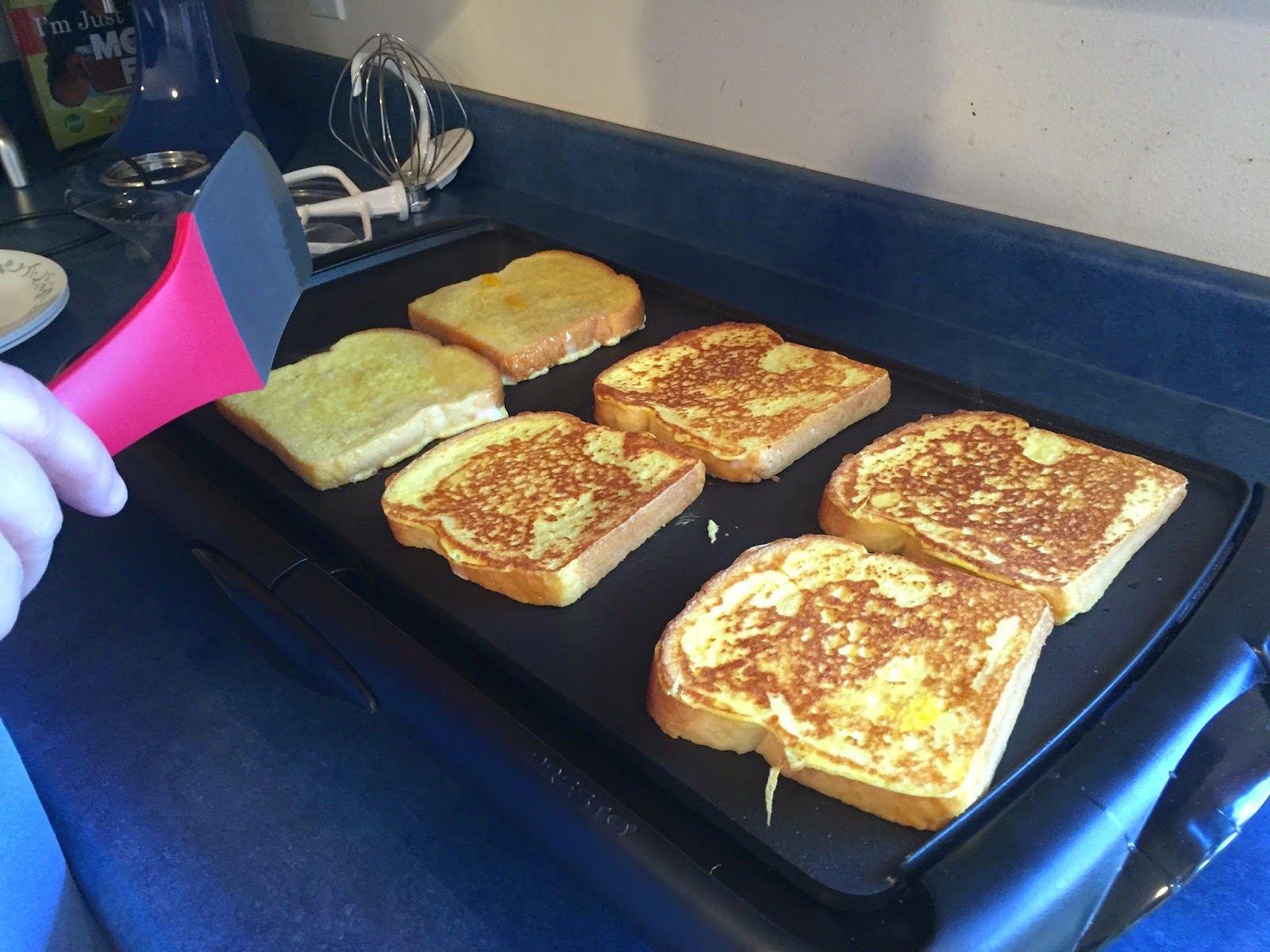

It's a nice way to start the day. And every chemo treatment is one step closer to "cured."
Along with autism comes a lot of food issues. This part of autism was not nearly as well understood when Alex was a toddler as it is today. Many (most?) individuals with autism have a restricted palette of foods that they eat. The issues may revolved around texture, color, smell or other concerns. It has always been difficult for Alex to try new foods. But spaghetti has always been a favorite.
Now spaghetti night has changed a bit. It's part of our new "chemo routine." We pick Alex up from his house on Wednesday, the night before chemo. We have spaghetti for dinner. I know that I can get him to eat well. It's sort of like carb-loading the night before a marathon. I also know that he isn't going to eat much for the two or three days after chemo, so I want to get him off to a good start.
So, we have spaghetti. Last night, spaghetti night was the night of LaVerne's funeral. I guess I was overtired and a bit distracted. I was wondering why the water wouldn't boil when I discovered that I never turned the burner on under the pasta pot. Well, I guess that's a problem. Then I burned two batches of garlic bread under the broiler. John managed to salvage part of the second batch and I gave up at that point. The spaghetti turned out well, though. Alex ate well, and we all crashed in front of reruns of Big Bang Theory.
The morning of chemo is French toast. It's a way to get an egg in Alex for the protein. He eats well in the morning the day of chemo. By lunch time, he may or may not be able to eat. Last time, he didn't eat all day. The time before, he ate lunch while getting his infusion and snacked throughout the day. We'll see what today brings.
John took over breakfast years ago. He doesn't have much of an interest in cooking, but he has become the breakfast king. So dad's French toast is the order of the day. The meals also provide comfort and routine and a bit of normalcy in what is our current life.
It's a nice way to start the day. And every chemo treatment is one step closer to "cured."
Subscribe to:
Posts (Atom)